Off the Top: Interaction Design Entries

20052010201520202025

Showing posts: 46-60 of 215 total posts


13 August 2007

Open Conversations and Privacy Needs for Business

I thought I would share the latest press bit around this joint, Thomas Vander Wal was quoted in Inc Magazine What's Next: Shout it Out Loud (or in the August 2007 issue beginning on page 69). The article focuses the need and desire for companies to share and be open with more of their data and information. Quite often companies are getting bit by their privacy around what they do (how their source their products/resources, who they donate money to, etc.) and rumors start. It is far more efficient and helpful to be open with that information, as it gets out anyway.

Ironically, in the same paper issue on page 26 there is a an article about When Scandal Knocks..., which includes a story about Jamba Juice and a blog post that inaccurately claimed it had milk in its products, which could have easily been avoided if Jamba Juice had an ingredients listing on its web site.

The Flip Side

There are two flip sides to this. One is the Apple converse, which is a rare example of a company really making a mythic organization out of its privacy. The second is companies really need privacy for some things, but the control of information is often too extreme and is now more harmful than helpful.

Viable Privacy

I have been working on a much longer post looking at the social software/web tools for and in the enterprise. Much of of the extreme openness touted in the new web charge is not a viable reality inside enterprise. There are a myriad of things that need to be private (or still qualify as valid reasons for many). The list include preparations for mergers and acquisitions, securities information dealings (the laws around this are what drive much of the privacy and are out dated), reorganizations (restructuring and layoffs, which organizations that have been open about this have found innovative solutions from the least likely places), personal employee records, as well as contractual reasons (advising or producing products for competitors in the same industry or market segment). Out side of these issues, which normally add up to under 30 to 40% of the whole of the information that flows through an organization, there is a lot of room for openness in-house and to the outside world.

Need for Enterprise Social Tools Grasping Partial Privacy

When we look at the consumer space for social software there are very few consumer tools that grasp social interaction and information sharing on a granular level (Ma.gnolia, Flickr, and the SixApart tools Vox and LiveJournal are the exceptions that always come to mind). But, many of the tools out there that are commonly used as examples of social web tools really fall down when business looks at them and thinks about privacy and selective sociality (small groups). The social web tools all around really need to grow up and improve in this area. As we are seeing the collaboration and social tools evolve to more viable options we start to see their more glaring holes that do not reflect the reality of human social interaction.

Closing the Gap

What we need is for companies to be more open so the marketplace is a more consumer and communicative environment, but we also need our still early social web tools to reflect our social realities that not everything is public and having tools that better fit those needs.

[Cross-posted at Personal InfoCloud: Open Converastions... with comments open on that posting.]


24 July 2007

Sharing and Following/Listening in the Social Web

You may be familiar with my granular social network post and the postings around the Personal InfoCloud posts that get to personal privacy and personal management of information we have seen, along with the Come to Me Web, but there is an element that is still missing and few social web sites actually grasp the concept. This concept is granular in the way that the granular social network is granular, which focusses on moving away from the concept of "broad line friends" that focus on our interest in everything people we "friend", which is not a close approximation of the non-digital world of friend that we are lucky to find friends who have 80 percent common interests. This bit that is missing focusses on the sharing and following (or listening) aspects of our digital relationships. Getting closer to this will help filter information we receive and share to ease the overflow of information and make the services far more valuable to the people using them.

Twitter Shows Understanding

Twitter in its latest modifications is beginning to show that it is grasping what we are doing online is not befriending people or claiming friend, but we are "following" people. This is a nice change, but it is only part of the equation that has a few more variables to it, which I have now been presenting for quite a few years (yes and am finally getting around to writing about). The other variables are the sharing and rough facets of type of information we share. When we start breaking this down we can start understanding the basic foundation for building a social web application that can begin to be functional for our spheres of sociality.

Spheres of Sociality

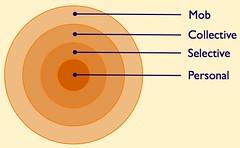
Spheres of Sociality The Spheres of Sociality are broken into four concentric rings:

  1. Personal
  2. Selective
  3. Collective
  4. Mob

There are echos of James Surowiecki's Wisdom of Crowds in the Spheres of Sociality as they break down as follows. The personal sphere is information that is just for one's self and it is not shared with others. The selective sphere, which there may be many a person shares with and listens to, are closed groups that people are comfortable sharing and participating with on common interests (family, small work projects, small group of friends or colleagues, etc.). The collective sphere is everybody using that social tool that are members of it, which has some common (precise or vague) understanding of what that service/site is about. The last sphere is the mob, which are those people outside the service and are not participants and who likely do not understand the workings or terminology of the service.

These sphere help us understand how people interact in real life as well as in these social environments. Many of the social web tools have elements of some of these or all of these spheres. Few social web tools provide the ability to have many selective spheres, but this is a need inside most enterprise and corporate sites as there are often small project teams working on things that may or may not come to fruition (this will be a future blog post). Many services allow for just sharing with those you grant to be your followers (like Twitter, Flickr, the old Yahoo! MyWeb 2.0, and Ma.gnolia private groups, etc.). This selective and segmented group of friends needs a little more examination and a little more understanding.

Granular Sharing and Following

Unequal AccessThe concepts that are needed to improve upon what has already been set in the Spheres of Sociality revolve around breaking down sharing and following (listening) into more discernible chunks that better reflect our interests. We need to do this because we do not always want to listen everything people we are willing to share with are surfacing. But, the converse is also true we may not want to share or need to share everything with people we want to follow (listen to).

In addition to each relationship needing to have sharing and listening properties, the broad brush painted by sharing and listening also needs to be broken down just a little (it could and should be quite granular should people want to reflect their real interests in their relationships) to some core facets. The core facets should have the ability to share and listen based on location, e.g. a person may only want to share or listen to people when they are in or near their location (keeping in mind people's location often changes, particularly for those that travel or move often). The location facet is likely the most requested tool particularly for those listening when people talk about Twitter and Facebook. Having some granular categories or tags to use as filters for sharing and listening makes sense as well. This can break down to simple elements like work, play, family, travel, etc. as broad categories it could help filter items from the sharing or listening streams and help bring to focus that which is of interest.

Breaking Down Listening and Sharing for Items

 YourselfOthers
ShareYesYes/No

Where this gets us it to an ability to quickly flag the importance of our interactions with others with whom we share information/objects. Some things we can set on an item level, like sharing or just for self, and if sharing with what parameters are we sharing things. We will set the default sharing with ourself on so we have access to everything we do. This follows the Spheres of Sociality with just personal use, sharing with selective groups (which ones), share with the collective group or service, and share outside the service. That starts setting privacy of information that starts accounting for personal and work information and who could see it. Various services have different levels of this, but it is a rare consumer services that has the selective service sorted out (Pownce comes close with the options for granularity, but Flickr has the ease of use and levels of access. For each item we share we should have the ability to control access to that item, to just self or out across the Spheres of Sociality to the mob, if we so wish. Now we can get beyond the item level to presetting people with normative rights.

Listening and Sharing at the Person Level

 Others
Settings
Listen/FollowYesNo
Granular
Listen/Follow
YesNo
Granular ShareYesNo
Geo Listen/FollowYesNo
Geo ShareYesNo

We can set people with properties that will help use with default Sphere of Sociality for sharing and listening. The two directions of communication really must be broken out as there are some people we do not mind them listening to the selective information sharing, but we may not have interest in listening to their normal flow of offerings (optimally we should be able to hear their responses when they are commenting on items we share). Conversely, there may be people we want to listen to and we do not want to share with, as we may not know them well enough to share or they may have broken our privacy considerations in the past, hence we do not trust them. For various reasons we need to be able to decide on a person level if we want to share and listen to that person.

Granular Listening and Sharing

Not, only do we have needs and desires for filtering what we share and listen to on the person level, but if we have a means to set some more granular levels of sharing, even at a high level (family, work, personal relation, acquaintance, etc.). If we can set some of these facets for sharing and have them tied to the Spheres we can easily control who and what we share and listen to. Flickr does this quite well with the simple family, friends, contacts, and all buckets, even if people do not use them precisely as such as family and friends are the two selective buckets they offer to work with (most people I know do not uses them precisely as such with those titles, but it provides a means of selective sharing and listening).

Geo Listening and Sharing

Lastly, it is often a request to filter listening and sharing by geography/location access. There are people who travel quite a bit and want to listen and share with people that are currently local or will be local to them in a short period, but their normal conversations are not fully relevant outside that location. Many people want the ability not to listen to a person unless they are local, but when a person who has some relationship becomes local the conversation may want to be shared and/or listened to. These settings can be dependent on the granular listening and sharing parameters, or may be different.

Getting There...

So, now that this is out there it is done? Hmmm, if it were only so easy. The first step is getting developers of social web and social software to begin understanding the social relationships that are less broad lines and more granular and directional. The next step is a social interaction that people need to understand or that the people building the interfaces need to understand, which is if and how to tell people the rights granted are not reciprocal (it is seems to be a common human trait to have angst over non-reciprocal social interactions, but it is the digital realm that makes it more apparent that the flesh world).


21 July 2007

Inline Messaging

Many of the social web services (Facebook, Pownce, MySpace, Twitter, etc.) have messaging services so you can communication with your "friends". Most of the services will only ping you on communication channels outside their website (e-mail, SMS/text messaging, feeds (RSS), etc.) and require the person to go back to the website to see the message, with the exception of Twitter which does this properly.

Inline Messaging

Here is where things are horribly broken. The closed services (except Twitter) will let you know you have a message on their service on your choice of communication channel (e-mail, SMS, or RSS), but not all offer all options. When a message arrives for you in the service the service pings you in the communication channel to let you know you have a message. But, rather than give you the message it points you back to the website to the message (Facebook does provide SMS chunked messages, but not e-mail). This means they are sending a message to a platform that works really well for messaging, just to let you know you have a message, but not deliver that message. This adds extra steps for the people using the service, rather than making a simple streamlined service that truly connects people.

Part of this broken interaction is driven by Americans building these services and having desktop-centric and web views and forgetting mobile is not only a viable platform for messaging, but the most widely used platform around the globe. I do not think the iPhone, which have been purchased by the owners and developers of these services, will help as the iPhone is an elite tool, that is not like the messaging experience for the hundreds of millions of mobile users around the globe. Developers not building or considering services for people to use on the devices or application of their choice is rather broken development these days. Google gets it with Google Gears and their mobile efforts as does Yahoo with its Yahoo Mobile services and other cross platform efforts.

Broken Interaction Means More Money?

I understand the reasoning behind the services adding steps and making the experience painful, it is seen as money in their pockets through pushing ads. The web is a relatively means of tracking and delivering ads, which translates into money. But, inflicting unneeded pain on their customers can not be driven by money. Pain on customers will only push them away and leave them with fewer people to look at the ads. I am not advocating giving up advertising, but moving ads into the other channels or building solutions that deliver the messages to people who want the messages and not just notification they have a message.

These services were somewhat annoying, but they have value in the services to keep somebody going back. When Pownce arrived on the scene a month or so ago, it included the broken messaging, but did not include mobile or RSS feeds. Pownce only provides e-mail notifications, but they only point you back to the site. That is about as broken as it gets for a messaging and status service. Pownce is a beautiful interface, with some lightweight sharing options and the ability to build groups, and it has a lightweight desktop applications built on Adobe AIR. The AIR version of Pownce is not robust enough with messaging to be fully useful. Pownce is still relatively early in its development, but they have a lot of fixing of things that are made much harder than they should be for consuming information. They include Microfomats on their pages, where they make sense, but they are missing the step of ease of use for regular people of dropping that content into their related applications (putting a small button on the item with the microformat that converts the content is drastically needed for ease of use). Pownce has some of the checkboxes checked and some good ideas, but the execution of far from there at the moment. They really need to focus on ease of use. If this is done maybe people will comeback and use it.

Good Examples

So who does this well? Twitter has been doing this really well and Jaiku does this really well on Nokia Series60 phones (after the first version Series60). Real cross platform and cross channel communication is the wave of right now for those thinking of developing tools with great adoption. The great adoption is viable as this starts solving technology pain points that real people are experiencing and more will be experiencing in the near future. (Providing a solution to refindability is the technology pain point that del.icio.us solved.) The telecoms really need to be paying attention to this as do the players in all messaging services. From work conversations and attendees to the Personal InfoCloud presentation, they are beginning to get the person wants and needs to be in control of their information across devices and services.

Twitter is a great bridge between web and mobile messaging. It also has some killer features that add to this ease of use and adoption like favorites, friends only, direct messaging, and feeds. Twitter gets messaging more than any other service at the moment. There are things Twitter needs, such as groups (selective messaging) and an easier means of finding friends, or as they are now appropriately calling it, people to follow.

Can we not all catch up to today's messaging needs?


18 July 2007

Does IBM Get Folksonomy?

While I do not aim to be snarky, I often come off that way as I tend to critique and provide criticism to hopefully get the bumps in the road of life (mostly digital life) smoothed out. That said...

Please Understand What You Are Saying

I read an article this morning about IBM bringing clients to Second Life, which is rather interesting. There are two statements made by Lee Dierdorff and Jean-Paul Jacob, one is valuble and the other sinks their credibility as I am not sure they grasp what they actually talking about.

The good comment is the "5D" approach, which combines the 2D world of the web and the 3D world of Second Life to get improved search and relevance. This is worth some thinking about, not a whole lot as the solution as it is mentioned can have severe problems scaling. The solution of a virtual world is lacking where it does not augment our understanding much beyond 2D as it leaves out 4 of the 6 senses (it has visual and audio), and provides more noise into a pure conversation than a video chat with out the sensory benefits of video chat. The added value of augmented intelligence via text interaction is of interest.

I am not really sure that Lee Dierdorff actually gets what he is saying as he shows a complete lack of even partial understanding of what folksonomy is. Jacob states, "The Internet knows almost everything, but tells us almost nothing. When you want to find a Redbook, for instance, it can be very hard to do that search. But the only real way to search in 5D is to put a question to others who can ask others and the answer may or may not come back to you. It's part of social search. Getting information from colleagues (online) -- that's folksonomy." Um, no that is not folksonomy and not remotely close. It is something that stands apart and is socially augmented search that can viably use the diverse structures of a folksonomy to find relevant information, but asking people in a digital world for advise is not folksonomy. It has value and it is how many of us have used tools like Twitter and other social software that helps us keep those near in thought close (see Local InfoCloud). There could be a need for a term/word for that Jacob is talking about, but social search seems to be quite relevant as a term.

Related, I do have a really large stack of criticism for the IMB DogEar product that would improve it greatly. It needs a lot of improvement as a social bookmarking and folksonomy tool, but also from the social software interaction side there are things that really must get fixed for privacy interests in the enterprise before it really could be a viable solution. There are much better alternatives for social bookmarking inside an enterprise other than DogEar, which benefits from being part of the IBM social software stack Lotus Connections as the whole stack is decent together, but none of the parts are great, or even better than good by them self. DogEar really needs to get to a much more solid product quickly as their is a lot of interest now for this type of product, but it is only a viable solution if one is only looking at IBM products for solutions.


17 June 2007

Stitching Conversation Threads Fractured Across Channels

Communicating is simple. Well it is simple at its core of one person talking with another person face-to-face. When we communicate and add technology into the mix (phone, video-chat, text message, etc.) it becomes more difficult. Technology becomes noise in the pure flow of communication.

Now With More Complexity

But, what we have today is even more complex and difficult as we are often holding conversation across many of these technologies. The communication streams (the back and forth communication between two or more people) are now often not contained in on communication channel (channel is the flavor or medium used to communicate, such as AIM, SMS, Twitter, e-mail, mobile phone, etc.).

We are seeing our communications move across channels, which can be good as this is fluid and keeping with our digital presence. More often than not we are seeing our communication streams fracture across channels. This fracturing becomes really apparent when we are trying to reconstruct our communication stream. I am finding this fracturing and attempting to stitch the stream back together becoming more and more common as for those who are moving into and across many applications and devices with their own messaging systems.

The communication streams fracture as we pick-up an idea or need from Twitter, then direct respond in Twitter that moves it to SMS, the SMS text message is responded back to in regular SMS outside of Twitter, a few volleys back and forth in SMS text, then one person leaves a voicemail, it is responded to in an e-mail, there are two responses back and forth in e-mail, an hour later both people are on Skype and chat there, in Skype chat they decide to meet in person.

Why Do We Want to Stitch the Communication Stream Together?

When they meet there is a little confusion over there being no written overview and guide. Both parties are sure they talked about it, but have different understandings of what was agreed upon. Having the communication fractured across channels makes reconstruction of the conversation problematic today. The conversation needs to be stitched back together using time stamps to reconstruct everything [the misunderstanding revolved around recommendations as one person understands that to mean a written document and the other it does not mean that].

Increasingly the reality of our personal and professional lives is this cross channel communication stream. Some want to limit the problem by keeping to just one channel through the process. While this is well intentioned it does not meet reality of today. Increasingly, the informal networking leads to meaningful conversations, but the conversations drifts across channels and mediums. Pushing a natural flow, as it currently stands, does not seem to be the best solution in the long run.

Why Does Conversation Drift Across Channels?

There are a few reasons conversations drift across channels and mediums. One reason is presence as when two people notice proximity on a channel they will use that channel to communicate. When a person is seen as present, by availability or recently posting a message in the service, it can be a prompt to communicate. Many times when the conversation starts in a presence channel it will move to another channel or medium. This shift can be driven by personal preference or putting the conversation in a medium or channel that is more conducive for the conversation style between people involved. Some people have a preferred medium for all their conversations, such as text messaging (SMS), e-mail, voice on phone, video chat, IM, etc.. While other people have a preferred medium for certain types of conversation, like quick and short questions on SMS, long single responses in e-mail, and extended conversations in IM. Some people prefer to keep their short messages in the channel where they begin, such as conversations that start in Facebook may stay there. While other people do not pay attention to message or conversation length and prefer conversations in one channel over others.

Solving the Fractured Communication Across Channels

Since there are more than a few reasons for the fractured communications to occur it is something that needs resolution. One solution is making all conversations open and use public APIs for the tools to pull the conversations together. This may be the quickest means to get to capturing and stitching the conversation thread back together today. While viable there are many conversations in our lives that we do not want public for one reason or many.

Another solution is to try to keep your conversations in channels that we can capture for our own use (optimally this should be easily sharable with the person we had the conversation with, while still remaining private). This may be where we should be heading in the near future. Tools like Twitter have become a bridge between web and SMS, which allows us to capture SMS conversations in an interface that can be easily pointed to and stitched back together with other parts of a conversation. E-mail is relatively easy to thread, if done in a web interface and/or with some tagging to pull pieces in from across different e-mail addresses. Skype chat also allows for SMS interactions and allows for them to be captured, searched, and pulled back together. IM conversations can easily be saved out and often each item is time stamped for easy stitching. VoIP conversations are often easily recorded (we are asking permission first, right?) and can be transcribed by hand accurately or be transcribed relatively accurately via speech-to-text tools. Voice-mail can now be captured and threaded using speech-to-text services or even is pushed as an attachment into e-mail in services as (and similar to) JConnect.

Who Will Make This Effortless?

There are three types of service that are or should be building this stitching together the fractured communications across channels into one threaded stream. I see tools that are already stitching out public (or partially public) lifestreams into one flow as one player in this pre-emergent market (Facebook, Jaiku, etc.). The other public player would be telecoms (or network provider) companies providing this as a service as they currently are providing some of these services, but as their markets get lost to VoIP, e-mail, on-line community messaging, Second Life, etc., they need to provide a service that keeps them viable (regulation is not a viable solution in the long run). Lastly, for those that do not trust or want their conversation streams in others hands the personally controlled application will become a solutions, it seems that Skype could be on its way to providing this.

Is There Demand Yet?

I am regularly fielding questions along these lines from enterprise as they are trying to deal with these issues for employees who have lost or can not put their hands on vital customer conversations or essential bits of information that can make the difference in delivering what their customers expect from them. Many have been using Cisco networking solutions that have some of these capabilities, but still not providing a catch all. I am getting queries from various telecom companies as they see reflections of where they would like to be providing tools in a Come to Me Web or facilitating bits of the Personal InfoCloud. I am getting requests from many professionals that want this type of solution for their lives. I am also getting queries from many who are considering building these tools, or pieces of them.

Some of us need these solutions now. Nearly all of us will need these solutions in the very near future.


15 June 2007

Skitch Goes Live Beta

Just a quick note to let you know Skitch has gone to invite only beta. I have some invites if you are interested and have been drooling for it to launch.

What is Skitch? It is a Mac OS X screen and cam capturing tool that not only allows you to capture the image, but annotate it, then send it out to Flickr, .Mac, or MySkitch (a skitch sharing site perfect for sharing with clients or collaborators). I have been using Skitch for the past few months and loving it. I have built-up a decent set of screen captures for presentations and client work (about 300+ elements) mostly around social web interaction patterns. It is an insanely easy (as well as fun) tool to use and I only wish I had it sooner.


13 June 2007

Full-Day Social Web & Folksonomy Workshop at d.construct

Tickets for the d.construct Workshops go on sale June 14, 2007. Buying a ticket for a full-day workshop provides free access to the full d.construct conference on September 7th. I am presenting the following workshop on September 6th...

Building the Social Web with Tagging / Folksonomies

On September 6th, 2007 Thomas Vander Wal will be holding his Building the Social Web with Tagging/Folksonomies — d.construct Workshop — at Brighton Dome, Brighton, England, UK.

Thomas Vander Wal, creator of the term folksonomy, provides a full-day workshop on building the social web through a detailed look at tagging systems. The workshop will provide a foundation for understanding social software from the perspective of the people who use it. This perspective helps site owners solve the ‘cold start’ problem of social software not starting out social.

The focus of the workshop is to provide a solid foundation for building and maintaining a social system from the design and management perspective. The workshop will cover policy issues, monitoring, analysis, and tagging systems as features that are added to the mix of existing tools.

The day will provide a brief history of tagging from the days of tagging in the desktop era to current web use. The exercises will focus on better understanding what happens in tagging systems and use those lessons to frame how to build better systems and make better use of the information that is made relevant through those tagging systems. The workshop includes overviews of social web pattern interaction design and the wide array of features.


1 June 2007

Off to Raleigh for DCampSouth

I am off to Raleigh tomorrow (Friday) as well as a stop in Chapel Hill Friday afternoon. I am head there to speak and participate in DCCampSouth. There is a good write-up of this free (yet FREE) event on the DCampSouth :: NC State Advanced Media Lab blog.

Swing by and chat about all things design.


3 March 2007

On SXSW Tag You're It Panel

I am a panelist on the Tag You're It Panel at South by SouthWest in Austin, Texas. Others on the panel are the ever fantastic: Heath Row (moderator), George Oates, and Ben Brown. The panel information:

Tag You're It on Saturday 10 March 2007 at 2:00 pm to 3:00 pm. The panel will be looking at what people are actually doing inside social tagging systems and where things have gone in the past couple years with tagging. We will get beyond the notion that tagging is cool by providing examples of how people are really using the tools in innovative and useful ways.

Stop by and say hello.


10 February 2007

Cuban Clocks and Music Long Tail Discovery

The last two trips to San Francisco I have heard a latin version of Coldplay's Clocks on KFOG and it really intrigued me. This last trip I was in the car for four songs and one of them was Coldplay's Clocks by the Cuban All Stars. I have been trying to track this track down since first hearing, but am not having great luck. This continually happens when I listen to KFOG, which is about the only regular radio station I will listen to (I much prefer XM Radio for is lack of advertising and blathering idiots spouting off while playing overplayed songs that have little merit.

What I like about this version of Clocks by the Cuban All Stars (I have seen the dashboard metadata list it as Ibrahim Ferrer, but it has not been described as such by the DJs on KFOG). This is where my music recommendations break. But, some digging on the KFOG website points me to Rhythms Del Mundo as the source (but their Flash site seems horribly broken in all browsers as none of the links work). I have found the album on iTunes, but only a partial listing and none of the physical music store options have this in stock as it is not mainstream enough (how I miss Tower).

This all seems like far more work that should be needed. But, not if one has even slightly long tail musical interests. I had a wonderful discussion along these lines wish Cory from IODA about this and the lack of really good long tail discovery systems.

I use Last.fm to discover new things from friend#039;s lists, but the Last.fm neighbor recommendations seem to only work on more mainstream interests (Pandora really falls off on the long tail for me). Now if KFOG put their play list in KFOG, it would help greatly and I would add them to my friend list (or I could move back home to the San Francisco Bay Area).


2 February 2007

Stikkit Adds an API

Stikkit has finally added an API for Stikkit. This makes me quite happy. Stikkit has great ease of information entry and it is perfect for adding annotations to web-based information.

Stikkit is My In-line Web Triage

I have been using Stikkit, from the bookmarklet, as my in-line web information triage. If I find an event or something I want to come back to latter (other than to read and bookmark) I pop that information into Stikkit. Most often it is to remind me of deadlines, events, company information, etc. I open the Stikkit bookmarklet and add the information. The date information I add is dumped into my Stikkit calendar, names and addresses are put into the Stikkit address book, and I can tag them for context for easier retrival.

Now with the addition of the API Stikkit is now easy to retrieve a vCard, ical, or other standard data format I can drop into my tools I normally aggregate similar information. I do not need to refer back to Stikkit to copy and paste (or worse mis-type) into my work apps.

I can also publish information from my preferred central data stores to Stikkit so I have web access to events, to dos, names and addresses, etc. From Stikkit I can then share the information with only those I want to share that information with.

Stikkit is growing to be a nice piece for microcontent tracking in my Personal InfoCloud.


31 January 2007

It is Finally IT and Design in Enterprise (and Small Business)

My recent trip to Northern California to speak at the UIE Web App Summit and meetings in the Bay Area triggered some good ideas. One thread of discovery is Enterprise, as well as small and medium sized business, is looking at not only technology for solutions to their needs, but design.

IT Traditions

Traditionally, the CIO or VP IT (and related upper management roles) have focussed on buying technology "solutions" to their information problems. Rarely have the solutions fixed the problems as there is often a "problem with the users" of the systems. We see the technology get blamed, the implementation team get blamed (many do not grasp the solution but only how to install the tools, as that is the type of service that is purchased), and then the "users need more training".

Breaking the Cycle of Blame and Disappointment

This cycle of blame and disappointment in technology is breaking around a few important realizations in the IT world.

Technology is not a Cure All

First, the technology is always over sold in capability and most often needs extensive modification to get working in any environment (the cost of a well implemented system is usually about the same as a built from scratch solution - but who has the resources to do that). Most CIOs and technology managers are not trusting IT sales people or marketing pitches. The common starting point is from the, "your tool can not do what you state" and then discussions can move from there. Occasionally, the tools actually can do what is promised.

Many, decision makers now want to test the product with real people in real situations. Solution providers that are good, understand this and will assist with setting up a demonstration. To help truly assess the product the technical staff in the organization is included in the set-up of the product.

People and Information Needs

Second, the problems are finally being identified in terms of people and information needs. This is a great starting place as it focusses on the problems and the wide variety of personal information workflows that are used efficiently by people. We know that technology solutions that mirror and augment existing workflows are easily adopted and often used successfully. This mirroring workflow also allows for lower training costs (occasionally there is no training needed).

Design with People in Mind

Third, design of the interaction and interface must focus on people and their needs. This is the most promising understanding as it revolves around people and their needs. Design is incredibly important in the success of the tools. Design is not just if it looks pretty (that does help), but how a person is walked through the steps easily and how the tools is easy to interact with for successful outcomes. The lack of good design is largely what has crippled most business tools as most have focussed on appealing to the inner geek of the IT manager. Many IT managers have finally realized that their interface and interaction preferences are not remotely representative of 95 percent of the people who need to or should be using the tools.

It is increasingly understood that designing the interaction and interface is very important. The design task must be done with the focus on the needs of real people who will be using the product. Design is not sprinkling some Web 2.0 magic dust of rounded corners, gradients, and fading yellow highlights, but a much deeper understanding that ease of use and breaking processes into easy steps is essential.

Smile to Many Faces

This understanding that buying a technology solutions is more than buying code to solve a problem, but a step in bringing usable tools in to help people work efficiently with information. This last week I talk to many people in Enterprise and smaller businesses that were the technical managers that were trying to get smarter on design and how they should approach digital information problems. I also heard the decision managers stating they needed better interfaces so the people using the tools could, well use the tools. The technology managers were also coming to grips that their preferences for interfaces did not work with most of the people who need the tools to work.

Technology Companies Go Directly to the Users

I have also been seeing the technology tool makers sitting with their actual people using their tools to drastically improve their tools for ease of use. One President of a technology tool maker explained it as, ":I am tired of getting the blame for making poor tools and losing contracts because the technology decision makers are not connected with the real needs of the people they are buying the tools for." This president was talking to three or four users on problems some of his indirect clients were having with a tool they really needed to work well for them. This guy knows the tech managers traditionally have not bought with the people needing to use the tools in mind and is working to create a great product for those people with wants and needs. He also knows how to sell to the technology managers to get their products in the door, but knows designing for the people using the product is how he stays in the company.


15 December 2006

Ghosts of Technology Past, Present, and Future

The past two days have brought back many memories that have reminded me of the advances in technology as well as the reliance on technology.

Ghost of Rich Web Past

I watched a walk through of a dynamic prototype yesterday that echoed this I was doing in 1999 and 2000. Well, not exactly doing as the then heavy JavaScript would blow up browsers. The DHTML and web interfaces that helped the person using the site to have a better experience quite often caused the browser to lock-up, close with no warning, or lock-up the machine. This was less than 100kb of JavaScript, but many machines more than two years old at that time and with browsers older than a year or two old did not have the power. The processing power was not there, the RAM was not there, the graphics cards were not powerful, and the browsers in need of optimizing.

The demonstration yesterday showed concepts that were nearly the exact concept from my past, but with a really nice interface (one that was not even possible in 1999 or 2000). I was ecstatic with the interface and the excellent job done on the prototype. I realized once again of the technical advances that make rich web interfaces of "Web 2.0" (for lack of a better term) possible. I have seen little new in the world of Ajax or rich interfaces that was not attempted in 2000 or 2001, but now they are viable as many people's machines can now drive this beauties.

I am also reminded of the past technologies as that is what I am running today. All I have at my beck and call is two 667MHz machines. One is an Apple TiBook (with 1 GB of RAM) and one is a Windows machine (killer graphics card with 256MB video RAM and 500MB memory). Both have problems with Amazon and Twitter with their rich interfaces. The sites are really slow and eat many of the relatively few resources I have at my disposal. My browsers are not blowing up, but it feels like they could.

Ghost of Technology Present

The past year or two I have been using my laptop as my outboard memory. More and more I am learning to trust my devices to remind me and keep track of complex projects across many contexts. Once things are in a system I trust they are mostly out of my head.

This experience came to a big bump two days ago when my hard drive crashed. The iterative back-ups were corrupted or faulty (mostly due to a permission issue that would alter me in the middle of the night). The full back-up was delayed as I do not travel with an external drive to do my regular back-ups. My regularly scheduled back-ups seem to trigger when I am on travel. I am now about 2.5 months out from my last good full back-up. I found an e-mail back-up that functioned from about 3 weeks after that last full backup. Ironically, I was in the midst of cleaning up my e-mail for back-up, which is the first step to my major back-up, when the failure happened.

I have a lot of business work that is sitting in the middle of that pile. I also have a lot of new contacts and tasks in the middle of that period. I have my client work saved out, but agreements and new pitches are in the mire of limbo.

Many people are trying to sync and back-up their lives on a regular basis, but the technology is still faulty. So many people have faulty syncing, no matter what technologies they are using. Most people have more than two devices in their life (work and home computer, smart phone, PDA, mobile phone with syncable address book and calendar, iPod, and other assorted options) and the syncing still works best (often passably) between two devices. Now when we start including web services things get really messy as people try to work on-line and off-line across their devices. The technology has not caught up as most devices are marketed and built to solve a problem between two devices and area of information need. The solutions are short sighted.

Ghost of the Technosocial Future

Last week I attended the University of North Carolina Social Software Symposium (UNC SSS) and while much of the conversation was around social software (including tagging/folksonomy) the discussion of technology use crept in. The topic of digital identity was around the edges. The topic of trust, both in people and technology was in the air. These are very important concepts (technology use, digital identity, and trusted technology and trusted people). There is an intersection of the technosocial where people communicate with their devices and through their devices. The technology layer must be understood as to the impact is has on communication. Communication mediated by any technology requires an understanding of how much of the pure signal of communication is lost and warped (it can be modified in a positive manner too when there are disabilities involved).

Our digital communications are improving when we understand the limitations and the capabilities of the technologies involved (be it a web browser of many varied options or mobile phone, etc.). Learning the capabilities of these trusted devices and understanding that they know us and they hold our lives together for us and protect our stuff from peering eyes of others. These trusted devices communicate and share with other trusted devices as well as our trusted services and the people in our lives we trust.

Seeing OpenID in action and work well gave me hope we are getting close on some of these fronts (more on this in another post). Seeing some of the great brains thinking and talking about social software was quite refreshing as well. The ability to build solid systems that augment our lives and bring those near in thought just one click away is here. It is even better than before with the potential for easier interaction, collaboration, and honing of ideas at our doorstep. The ability to build an interface across data sets (stuff I was working on in 1999 that shortened the 3 months to get data on your desk to minutes, even after running analytics and working with a GIS interface) can be done in hours where getting access to the wide variety of information took weeks and months in the past. Getting access to data in our devices to provide location information with those we trust (those we did not trust have had this info for some time and now we can take that back) enables many new services to work on our behalf while protecting our wishes for whom we would like the information shared with. Having trusted devices working together helps heal the fractures in our data losses, while keeping it safe from those we do not wish to have access. The secure transmission of our data between our trusted devices and securely shared with those we trust is quickly arriving.

I am hoping the next time I have a fatal hard drive crash it is not noticeable and the data loss is self-healed by pulling things back together from resources I have trust (well placed trust that is verifiable - hopefully). This is the Personal InfoCloud and its dealing with a Local InfoCloud all securely built with trusted components.


4 December 2006

Let Me Count the 24 Ways

It is that wonderful time of the year for 24 ways, the wonderful 24 gifts from one web developer to the rest of us. I deeply enjoyed them last year and am looking forward to the remainder of the gems.


21 November 2006

Personal Twitter Use

Early this past summer I started playing with Twitter (then donning the moniker "twttr"). It drove me absolutely bonkers. I could not sort out how to stop my handful of friends from dumping their, "I had a gorgonzola cheese sandwich" into my SMS. I would be in a meeting or giving a presentation and my phone would vibrate with this micro-blogging nothingness of life status updates.

Since then I stopped pushing anything, but direct responses, to SMS or e-mail. This really made Twitter much better. But, then I was not peeking at it. In the past month or two I have had it running as a regular tab in my browser and it is much better, it does not scream for my attention, but acts more like me looking across a bar to see what my friends are doing. It is now a nice social space with quiet chatter.

Last week when I was in San Francisco I was using Twitter and Dodgeball, but found my friends in SF mostly using Dodgeball at night and I was mostly not in proximity (I only have one person in my DC network on Dodgeball). The Dodgeball demands to connect with Google account pushed me over from logging in, which is the last thing I want.

Twitter in SF worked wonderfully. I could state a meeting was shifted and announce I was going to get coffee and would find another person that wanted to join up to do the same. I found others doing the same and I would join them. I could also partake in cross continent chatter with friends.

This week I moved Twitter out to its own narrow (it needs to be even narrower - is there a Greasemonkey script to make it narrow) window. I keep it on my large monitor to my right, which is my social space (calendar, skype, YIM, AIM/iChat, and now Twitter). These are my social glancing applications and Twitter is a really nice compliment to the pack of Local InfoCloud tools, now that I have it set to match my expectations and desire for interruptions (or desire for minimal interruptions).


This work is licensed under the Creative Commons Attribution-NonCommercial-ShareAlike License.