Off the Top: Interaction Design Entries

20052010201520202025

Showing posts: 31-45 of 215 total posts


22 February 2008

Remote Presentation and Perception Matrix for Social Tools

This post is also found at: Remote Presentation and Perceptions Matrix for Social Tools :: Personal InfoCloud with moderated comments turned on.]

Today I did something I had never done before (actually a few things) I sat in my office in my home and gave a live web video presentation to a conference elsewhere on the globe. I presented my nearly all new presentation, Keeping Up With Social Tagging to the Expert Workshop in: Social Tagging and Knowledge Organization - Perspectives and Potential that was put on by the Knowledge Media Research Center in Tübingen, Germany.

Remote Presentation Feelings

While the remote video presentation is normal for many people inside their large organizations and I have presented at meetings and conferences where my presentation was provided to other location on live video feed (my recent Ann Arbor trip to present at STIET was HD broadcast to Wayne State in Detroit), this home office to conference presentation was new to me. The presentation and video link used Adobe Connect, which allowed me to see whom I was talking to, manage my slides, text chat, and see myself. This worked quite well, much better than I expected. I did have my full slide presentation in lightroom view set up in Keynote on my external monitor on the side and used Awaken on the side monitor as well to help with timing.

The ability to get feedback and watch the attendees body language and non-verbal responses was insanely helpful. I have given webinars and done phone presentations where I had not visual cues to the audience responses, which I find to be a horrible way to present (I often will expand on subjects or shorten explanations based on non-verbal feedback from the audience). Adobe Connect allowed this non-verbal feedback to be streamed back to me, which completely allows me to adjust the presentation as I normally do.

One thing that was a wee bit difficult was having to change focus (I suppose that comes with use and experience), but I would watch audience feedback while presenting, peek to the side to see where I was with time and slides (to work in the transitions), but would then try to look at the camera to "connect". Watching myself on the video feedback the moments I would try to connect through the camera I would open my eyes wide as if trying to see through my iSight and boy does that come across looking strange on a close range camera. I also (unknown to myself until recently watching a video of another presentation I had done) use a similar facial expression to add emphasis, I am realizing with a camera as close as it is for web presentation also really looks odd. I am sort of used to listening to myself (normally to write out new analogies I use or responses to questions), but watching myself in playback from that close of a range is really uncomfortable.

One thing I really missed in doing this web video presentation was extended interaction with the attendees. I rather enjoy conferences, particularly ones with this focussed a gathering as it makes for great socializing with people passionate about the same subjects I am passionate about. I like comparing note, perceptions, and widely differing views. It helps me grow my knowledge and understandings as well as helps change my perceptions. Live face-to-face conversation and sharing of interests is an incredibly value part of learning, experiencing, and shaping views and it is something I greatly enjoy attending conferences in person. I am not a fan of arriving at a conference just prior to a presentation, giving the presentation, and then leaving. The personal social interaction is valuable. The video presentation does not provide that and I really missed it, particularly with the people who are so closely tied to my deep interest areas as this workshop was focused.

New Content in Presentation

This presentation included a lot of new content, ideas, and concepts that I have not really presented or written about in as open of a forum. I have received really strong positive feedback from the Faces of Perception, Depth of Perception, and Perception Matrix when I have talked about it with people and companies. I have included this content in the book on social bookmarking and folksonomy I am writing for O&Reilly and pieces have been in public and private workshops I have given, but it was long past time to let the ideas out into the open.

The components of perception came about through reading formal analysis and research from others as well as not having a good models myself to lean on to explain a lot of what I find from social computing service providers (web tools in the Web 2.0 genre as well as inside the firewall Enterprise 2.0 tools) as tool makers or service owners. The understandings that are brought to the table on a lot of research and analysis is far too thin and far too often badly confuses the roles and faces of the tool that are being reviewed or analyzed. In my working with tool makers and organizations implementing social tools the analysis and research is less than helpful and often makes building products that meet the user needs and desires really difficult. I am not saying that this conceptual model fixes it, but from those who have considered what it shows almost all have had realizations they have had a less than perfect grasp and have lacked the granularity they have needed to build, analyze, or research these social tools.

I am hoping to write these perspectives up in more depth at some point in the not too distant future, but the video and slides start getting the ideas out there. As I have been walking people through how to use the tools I have been realizing the content needed to best us the model and matrix may take more than a day of a workshop of even a few days to get the most complete value from it. These tools have helped me drastically increase my value in consulting and training in the very short time I have used them. Some are finding that their copying of features and functionality in other social services has not helped them really understand what is best for their user needs and are less than optimal for the type of service they are offering or believe they are offering.


11 February 2008

Challenges as Opportunities for Social Networks and Services

Jeremiah Owyang posts "The Many Challenges of Social Network Sites" that lays out many of the complaints that have risen around social networking sites (and other social computing services). He has a good list of complaints, which all sounded incredibly familiar from the glory days of 1990 to 1992 for IT in the enterprise (tongue firmly planted in cheek). We have been through these similar cycles before, but things are much more connected now, but things also have changed very little (other than many of the faces). His question really needs addressing when dealing with Enterprise 2.0 efforts as these are the things I hear initially when talking with organizations too. Jeremiah asked for responses and the following is what I posted...

Response to Challenges of Social Network/Services

The past year or two, largely with Facebook growing the social networks and social computing tools have grown into the edges of mainstream. Nearly every argument made against these tools and services was laid down against e-mail, rich UI desktops (people spent hours changing the colors and arranging the interfaces), and IM years ago.

Where these tools are "seemingly" not working is mostly attributed to a severe lack of defining the value derived from using the tools. These news tools and services, even more so those of us working around them, need to communicate how to use the tools effectively and efficiently (efficiently is difficult as the many of the tools are difficult to use or the task flows are not as simple as they should be). The conceptual models & frameworks for those of us analyzing the tools have been really poor and missing giant perspectives and frameworks.

One of the biggest problems with many of these tools and services is they have yet to move out of early product mode. The tools and services are working on maturity getting features in the tools that people need and want, working on scaling, and iterating based on early adopters (the first two or three waves of people), which is not necessarily how those who follow will use the tools or need the tools to work.

Simplicity and limited options on top of tools that work easily and provide good derived value for the worklife and . As the tools that were disrupters to work culture in the past learned the focus needs to be on what is getting done and let people do it. Friending people, adding applications, tweaking the interface, etc. are not things that lead to easy monetization. Tools that help people really be social, interact, and get more value in their life (fun, entertainment, connecting with people near in thought, filtering information from the massive flow, and using the information and social connections in context where people need it) from the tools is there things must head. We are building the platforms for this, but we need to also focus on how to improve use of these platforms and have strong vision of what this is and how to get there.

[This is also posted at Challenges as Oppotunities for Social Networks and Services :: Personal InfoCloud with moderated comments turned on.]


8 February 2008

Getting More Value In Enterprise with Social Bookmarking

The last few weeks I have been running across a few companies postponing or canceling their social computing or Enterprise 2.0 efforts. The reasons vary from the usual budget shifts and staff changes (prior projects were not delivered on time), and leadership roles need filling. But two firms had new concerns of layoffs or budget cuts.

To both firms I pointed out now was the exact time they really needed to focus on some Enterprise 2.0 efforts, particularly social bookmarking as well as wikis and blogs. These solutions help gather information, find value across the organization, capture knowledge, build cohesiveness for members of the organization in time where there there is uncertainty. One of the biggest reasons that these tools make sense is their cost to deploy and receive solid value. As Josh Bernoff  (and others in from Forrester) points out in the Strategies For Interactive Marketing In A Recession free report from Forrester, the cost to deploy is in the $50,000 to $300,000 range (usually more expensive for large and more complex deployments).

Social Bookmarking has Great Value in the Enterprise

Every organization needs to know itself better then they currently do. The employees and members of the organization are all trying to do their job better and smarter. The need to connect people inside an organization with others with similar interest, contexts, and perceptions is really needed. I am a huge fan of social bookmarking tools to help along these lines as it helps people hold on to information they have need, want, or have interest in (particularly with future uses) and put things in their own context and perception. Once people understand the value they derive from using the tools to hold on to information out of their vast flow and streams of information and data that run before them each day they quickly "get it". As people also share these bookmarks in the organization with their tags and annotations, they also realize quickly they are becoming a valuable conduit to helping others find information and they grasp the value they will derive from being a resource that adds value in the organization. Other people derive value from information in the organization and outside it being augmented with individual perspectives and context. When this is pair with search, as Connectbeam does with their social search that pairs with existing FAST, Google Search Appliance, and others in-house search engines, the value the whole organization receives is far beyond the cost and minimal effort people are putting into the tools to get smarter, by more easily holding on and sharing what they know.

Nearly every attendee to the workshops I have put on around this subject quickly realizes they undervalued the impact and capability of social bookmarking (as well as other social computing tools) in the enterprise. The also provides a strong foundation for better understanding social computing to increase the derived value for all parties (individuals, collective users, collaborative users, and the organization).

Is is time for your enterprise to get smarter and provide more value inside and out?

[This is also blogged at Getting More Value In Enterprise with Social Bookmarking :: Personal InfoCloud with moderated comments turned on.]


5 February 2008

Social Computing Summit in Miami, Florida in April, 2008

ASIS&T has a new event they are putting on this year, the Social Computing Summit in Miami, Florida on April 10-11, 2008 (a reminder page is up at Yahoo's Upcoming - Social Computing Summit). The event is a single-track event on both days with keynote presentations, panels, and discussion.

The opening keynote is by Nancy Baym. I have been helping assist with organization of the Social Computing Summit and was asked by the other organizers to speak, which I am doing on the second day. The conference is a mix of academic, consumer, and business perspectives across social networking, politics, mobile, developing world, research, enterprise, open social networks (social graph and portable social networks) as well as other subjects. The Summit will be a broad view of the digital social world and the current state of understanding from various leaders in social computing.

There is an open call for posters for the event that closes on February 25, 2008. Please submit as this is looking to be a great event and more perspectives and expertise will only make this event more fantastic.


14 January 2008

Ma.gnolia Goes Mobile

On Friday Ma.gnolia rolled out a mobile version of their site, M.gnolia - Mobile Ma.gnolia. This had me really excited as I now have access to my bookmarks in my pocket on my mobile. Ma.gnolia gives a quick preview in their blog post Ma.gnolia Blog: Flowers on the Go.

What Mobile Ma.gnolia Does and Does Not Do

First, off the mobile Ma.gnolia does not have easy bookmarking, which is not surprising given the state things in mobile browsers. I really do not see this as a huge downside. What I am head over heals happy about is access to my bookmarks (all 2800 plus). The mobile version allows searching through your own tags (if you are logged in). It currently has easy access to see that is newly bookmarked in Ma.gnolia groups you follow, your contact's bookmarks, popular bookmarks, your own tags, and your profile.

Mobile Site Bookmarks

One thing that is helpful for those that use mobile web browsing is having easy access to mobile versions of web sites. Yes, the iPhone and many smartphone users (I am in the Nokia camp with my well liked E61i) can easily browse and read regular web pages, but mobile optimized pages are quicker to load and have less clutter on a smaller screen. The iPhone, WebKit-based browsers (Nokia), Opera Mini, and other decent mobile web browsers all have eased mobile browsing use of regular webpages, but having a list of mobile versions is really nice.

Yesterday, Saturday, I created a Ma.gnolia Mobile Version Group so people can share web pages optimized for mobile devices (quicker/smaler downloads, smaller screens, less rich ads, etc.). One of the ways I was thinking people could use this is to find sites in this group then bookmark them for their own use with tags and organization that makes sense for themself. The aim is just to collect and share with others what you find helpful and valuable for yourself. This group will be monitored for spam as the rest of Ma.gnolia is (Ma.gnolia uses "rel="no-follow"" so there really is little value to spammers).

Ways You Can Use Mobile Ma.gnolia

This means if you tagged a store, restaurant, bar, transit site, or other item that has value when out walking around it is really nice to have quick access to it. It can also be a great way to read those items you have tagged "to read" (if you are a person that tags things in that manner) so you can read what you want in the doctor's office, bus, train, or wherever.

I have a lot of content I have bookmarked for locations I am work, live, and visit. When I come across something I want to remember (places to eat, drink, learn, hang, be entertained, etc.) I often dump them into the bookmarks. But, getting to this information has been painful from a mobile in the past. I am now starting to go back to things I have tagged with locations and add a "togo" tag so they are easier for me to find and use in the Ma.gnolia mobile interface. I have already added a bookmark for an museum exhibit that I really want to see that is not far from where I am. When a meeting is dropped, postponed, or runs short near the museum I can make a trip over and see it. There is so much information flowing through my devices and it is nice to be able to better use this info across my Personal InfoCloud in my trusted devices I have with me and use the information in context it is well suited for, when have stepped away from my desk or laptop.

I am looking forward to see where this goes. Bravo and deep thanks to the Larry and others at Ma.gnolia that made this happen!


10 January 2008

Posting Elements of the Social Software Stack

I have been working for quite on finding a good way to explain the elements in the social software stack (or most of the important ones). I have blogged the result of the work as The Elements in the Social Software Stack (comments are open there).

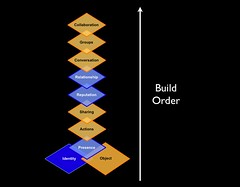
In my public and in-house workshops I have worked through various graphics from others and my own to work as a foundation for talking to and through the subject. In November I finally sat down (in a hallway open space) the day before my workshop at the IA Konferenz in Stuttgart, Germany. It had all the elements that are part of a solid foundation, in progressive order:

  1. Identity
  2. Object (social object)
  3. Presence
  4. Actions
  5. Sharing
  6. Reputation
  7. Relationships
  8. Conversation
  9. Groups
  10. Collaboration

This and one other post that is in the works are becoming the corner stones for my work helping start-ups and enterprise work through social software (social computing) to properly solve their problems and address the issues at hand. It has also been the foundation for rethinking (mostly more clearly thinking about) social bookmarking and folksonomy. I am rewriting the work I have done toward the book based on these two pieces as it is making the communication of concepts clearer.

Who Does This Help?

People looking at the social software services should have a solid idea of the central elements, identity and the social object. After that it is a building process to account for the other elements leading up to the services full offerings. Social bookmarking (folksonomy related services) should get up to or include conversation. Tools like Ma.gnolia go up to groups for their social bookmarking service and they cover the elements leading up to that end point.

There is more that can be fleshed out in this, but it is a foundation and a starting point. The next piece will build on this posting and should be a good foundation for understanding.

Still here? Go read The Elements in the Social Software Stack :: Personal InfoCloud and offer constructive feedback. Thank you.


7 December 2007

Pffft! Social Graph, We Need the Portable Social Network

In reading Alex Rudloff's "Privacy as Currancy" post I had two thoughts reoccur: 1) privacy is a currency back by trust; and 2) Pfffft! Social graph? Where is my Portable Social Network?

I agree with what Alex stated about wanting to move out of Facebook as my trust in them is gone completely (mostly driven by even though they apologized (poorly) Facebook still receives trackings of all your travels on the internet after you opt out, Om Malik's Zuckerberg's Mea Culp, Not Enough, and Brian Oberkirk's Facebook Harder to Shake than the Columbia Record Tape Club (a great read on the hurdles of really getting out of Facebook)). I will likely blog about the relationship between privacy and trust in another post in the not too distant future, as I have been talking about it in recent presentations on Social Software (Going Social and Putting Users First).

The Dire Need for Portable Social Networks

When Alex states:

Beacon had me so freaked out that I walked through what would happen if I simply removed my account (my natural, gut reaction). The fact is, I'd lose contact with a lot of people instantly. There's no easy way for me to take my data out and apply it somewhere else. There is no friend export and there isn't anywhere suitable for me to go.

I think we need portable social networks (or Social Network Portability as it is also known) before we need the social graph. Part of the interest in the social graph (mapping the relationships) is based on Facebook, but Facebook is a really poor interface for this information, it has some of the connections, some of the context, but it is not granular and does not measure strength (strong or weak ties) of relationships on a contextual and/or a preferential interest level. This social graph does little to help us move from one social software service to another other than to show a linkage.

There are strong reasons for wanting and needing the Portable Social Network. One is it makes it easy to drop into a new social software service and try it with social interactions with people whom we are already having social interactions. Whilst this is good it is also really important if something tragic or dire happens with a social software service we are already using, such as it is shut down, it is no longer performing for us, or it has given us a reason to leave through loss of trust. As I noted in the past (Following Friends Across Walled Gardens") leaving social software services is nothing new (even predates people leaving Delphi for Prodigy and Prodigy for AOL, etc.), but we still are not ready for this seemingly natural progression of moving house from one walled off social platform for another.

The Call for Action for Portable Social Network is Now

I am finding many of my friends have put their Facebook account on in hibernation (Facebook calls it &#quot;deactivation") and many have started taking the painful steps of really getting all of their information out of Facebook and planning to never go back. My friends have not sorted out what robust social software platform they will surface on next (many are still using Flickr, Twitter, Pownce, Tumblr and/or other options along with their personal blogs), but they would like to hold on to the digital statements of social relationship they made in Facebook and be able to drop those into some other service or platform easily.

One option could a just having a Smart Address Book or as Tim O'Reilly states Address Book 2.0. I believe that this should be a tool/service should have the relationships private and that privacy is controlled by the individual that owns the address book, possibly even accounting for the privacy request of the person whose address is in the address book. But, this is one option of many.

The big thing is we need Portable Social Networks now! This is not a far off in the future need it is a need of today.

[Comments are open on the syndicated post at Pffft! Social Graph, We Need the Portable Social Network :: Personal InfoCloud]


4 December 2007

Finding Real Community

This past week was really rough, but a good lightbulb moment for community. My wife had a bad fall on steps and badly broke her ankle. The response has been overwhelming from the people in our physical neighborhood, but also on Twitter and to a lesser degree on Facebook. The ability to hear from people offering condolence but offering assistance has been incredible. I lost track of the feedback on Twitter after 80 responses, all from a group of friends and collaborators I share with regularly. I have a similar number of connections in Facebook, but only received 10 or so responses (largely because the interface in Facebook is poor for tracking all presence messaging with social networks that scale (I have discussed this before in Facebook for Business or LinkedIn Gets More Valuable and Can Facebook Change Its DNA?).

An Expanded Network of Caring

The people in the neighborhood bring food and offering help has been really comforting. I hear many people now living neighborhood where they do not know their neighbors and do not have this caring. I feel very fortunate to have a traditional neighborhood that cares.

The Twitter responses blew me away, as the sincerity and support went far beyond any offerings of connections in the past. Twitter has acted like a local neighborhood but with global connections. There are continual complaints about Twitter not being real community, but the short messages (140 characters), the interface, and flow to people I have personal contact with (not face to face, but just as real) is utterly impressive. Twitter triggered IMs, SMS, and messaging through Twitter. It was simple best wishes to many offers of being available for support to talk and offers to send anything needed.

This really floored me as it is an extension of humanity in the most touching way (other than face-to-face). Twitter has been my social environment for humor, sharing, calls for assistance (out and responding to), and in many ways that my old physical office space used to provide, but now the people connected are many more and it is far more manageable. I have grown accustom to this closeness and alternate means of socializing, but was still amazed with the real caring response.


3 November 2007

Can Facebook Change Its DNA

I wrote and posted Can Facebook Change Its DNA as a follow-up to for Business or LinkedIn Gets More Valuable regarding the changes needed in Facebook if it wants to be valuable (or have optimal value) for the business world.


18 October 2007

The State of Enterprise Social Software - Pointer

I have written and posted The State of Enterprise Social Software on my Peronal InfoCloud blog as it has comments on and it also is where I am trying to keep my more professional pieces.

This blog post is a reaction to Richard McManus excellent post Big Vendors Scrap for Enterprise 2.0 Supremacy. The post seemed less about supremacy than scapping to be relevant. Many of the tools I am quite or somewhat familiar with and rather unimpressed. But, go read the other post to find my assessments of the tools, but also the tools that are doing much better jobs than the traditional enterprise vendors.


14 October 2007

Facebook for Business or LinkedIn Gets More Valuable

Michael Arrington writes about Facebook has LinkedIn in their Crosshairs, but I have been finding Facebook becoming increasingly less valuable the more people I have connected in it. The converse is opposite for me, LinkedIn becomes incredibly more valuable the more people I have in it. The reason for my derived value is simplicity.

LinkedIn Scales Quite Well the More Connections a Person Has

LinkedIn focusses on a simple set of things (your connections, changes to your connections, simple activities by your connections, and connecting with other people) and lets the person using the service derive value. LinkedIn lets be easily download the updated vCard, which drops into my address book in two different applications, which I have syncing with my mobile device (now that I have a mobile device that does not suck). LinkedIn is partly passive for me as I leave it own in a tab in my browser and check it a few times a day, but where a contact updates their status I can update my address book and it is a trigger for me to send a note, using the services they prefer (I keep track of that). LinkedIn is moving to opening its service with an API as they blogged (The LinkedIn API Opportunity). This will permit other services that can add value and are also great at what they do to pair the services, like Dopplr or a calendar to show availability (a particular need of mine). LinkedIn understands the information in their service has value and is more valuable outside their service for many people. But, LinkedIn also understands a good interface that is not cluttered, and there for it can scale.

Facebook Scales Poorly the More People A Person is Connected To

Facebook has a few things going for it, a huge mass of people with accounts and it has a fairly good lifestream interface for one's friends. The value for people using Facebook for themselves is much less than the high dollar valuations given to it (the valuation is not because it is a great service or tool, but because they have a ton of accounts in the service that creates value for advertisers). A few weeks ago I posted some Facebook frustrations in Twitter that stated:

"Facebook is driving me absolutely nuts - there is no way to manage information or conversations"
"Facebook is like a grade school lunch room, cacophony and chaos as the rule of nature"
&auot;FAcebook has a lot of valuable bits of information flowing through it from my contacts, but it FAILS to allow be to do anything with them"

Unlike Twitter, which allows me to favorite bits of information that I find valuable, Facebook does not grasp that the information has value. They do not grasp that those of us people who use their service are sharing things with those we connect with (friends, acquaintances, work relations, etcera) and we would like these people to see this information. Facebook interface started breaking for me finding information shared for my seeing (along with many others) with about 75 connections. It became virtually unusable with 150 people. There is information about events, blog posts, published journal articles, job changes, travel to cities I will be in (the Dopplr application is helpful, but if does not make a connection to those people in Facebook and the information I should be seeing), and other helpful valuable information for me.

Not only was I having this problem, but I was getting many e-mails and messages through Twitter with my friends and contacts severe problems with the poor (at best) Facebook platform. Nearly every person I heard from had many instances of broken communication because Facebook has yet to sort out volumes of information and surface it in a manner that can be valuable for the people it is intended to communicate with.

Facebook developers have a huge amount of learning about information, information flow, and information use in people's lives. Information is part of social interaction and what makes literate beings stand out is doing something, often using and reusing information. One common statement about Facebook from friends of all ages is it is a service to connect to people and play Scrabble on, but that is the end of the value. Facebook really needs to wake up and build real APIs that allow ease of holding on to the information people share as part of their being social humans sharing. When Facebook broke the FacebookSync.app it ruined one of the solid values Facebook provided, updating my address book with ease from information my friends were sharing with me.

Facebook Groups Have Learned Nothing from Group Messaging Platforms

One area that is really frustrating is Facebook#039;s groups. Many groups start with good intentions of providing a place to gather and message around a subject area. But, most groups already have listserves and other discussion platforms and the walled garden and horrible group discussion board platform make the Facebook platform a distraction and only providing a means for communication fractured across channels. Finding valuable information in Facebook groups or reading and following along is horribly painful, there has been some good advancement in groups discussion forums in the past 20 years, but Facebook seems to have ignored all things good with groups.

There are some exceptions to this rule, as the Facebook group for Victoria Secret Pink has been brought up as an example by more than five of my clients in the last five months or so. The Pink group has good community leaders and engages the people in the group to connect with others.

Successful Social Group Filtering is Needed

One of the fixes that Facebook needs is the same fix that every group discussion platform (listserves, threaded discussions, and web platforms) needs. Popular discussion boards have problems as they scale and over time with repetitive discussions. After people have been lurkers or participants in a discussion services for a few months (some people grasp this much more quickly) trends appear. The trends are the identifying people we find add value for us personally (every person has different valued contributors) and there are subjects that we want to listen to and participate in and those we have little interest in. The next step for these tools will be to surface people we find valued contributions from and subjects we want to pay attention to and others that we want to not listen to (unless one of our valued contributors jumps in the conversation). Not all contributors are valuable to us in all groups, so that needs to have granular listening attributes and we need to have fuzzy semantic terms (we set a word or few and terms that are related to these words will draw our reader's attention and filter them out for us to easily see and follow). These solutions are also needed in RSS feeds and aggregated information services.

The Future of LinkedIn and Facebook

LinkedIn already is a good business tool with value and they need to protect what they do well, which is holding on to people we have met and interacted with outside LinkedIn and use LinkedIn to connect with others with similar interests or needs. Opening up the API for LinkedIn could help people share their linked in profile though mobile devices so to gather a digital business card or easily get a link to it as we meet people, not hours, days, or weeks later.

Facebook has a decent platform that offers more than the pure social network tools before it (Ryze, Friendster, Orkut, or MySpace), but it still has an really long way to go. It gets about 40% right, but it can easily just be another step forward for social networking tools, unless it starts solving some of the difficult problems. A Facebook like tool that gets communication and sharing right at scale for professionals will do really well. Tools like this are needed inside the firewall for enterprise and Facebook does have value in its current state for business, but it is really limited.

The promised addition of grouping contacts in Facebook will help provide a better tool for profession needs separating out value from the playful, but it will need a lot more than that. Facebook really needs to open up and to get a clue about people and information and the needs people have for information, such as holding on to that information and using it outside the system. Facebook is just fodder for the next social software service that does this right, on top of the 45% of things that Facebook got right and be the next media darling worth billions that never amounted to much.


30 August 2007

A Stale State of Tagging?

David Weinberger posted a comment about Tagging like it was 2002, which quotes Matt Mower discussing the state of tagging. I mostly agree, but not completely. In the consumer space thing have been stagnant for a while, but in the enterprise space there is some good forward movement and some innovation taking place. But, let me break down a bit of what has gone on in the consumer space.

History of Tagging

The history of tagging in the consumer space is a much deeper and older topic than most have thought. One of the first consumer products to include tagging or annotations was the Lotus Magellan product, which appeared in 1988 and allowed annotations of documents and objects on one's hard drive to ease finding and refinding the them (it was a full text search which was remarkably fast for its day). By the mid-90s Compuserve had tagging for objects uploaded into its forum libraries. In 2001 Bitzi allowed tagging of any media what had a URL.

The down side of this tagging was the it did not capture identity and assuming every person uses words (tag terms) in the same manner is a quick trip to the tag dump where tags are not fully useful. In 2003 Joshua Schacter showed the way with del.icio.us that not only allowed identity, upon which we can disambiguate, but it also had a set object in common with all those identities tagging it. The common object being annotated allows for a beginning point to discern similarity of identityĵs tag terms. Part of this has been driven on Joshua's focus on the person consuming the content and allowing a means for that consumer to get back to their information and objects of interest. (It is around this concept that folksonomy was coined to separate it from the content publisher tagging and non-identity related tagging.) This picked up on the tagging for one's self that was in Lotus Magellan and brings it forward to the web.

Valuable Tagging

It was in del.icio.us that we saw tagging that really did not work well in the past begin to become valuable as the clarity in tag terms that was missing in most all other tagging systems was corrected for in the use of a common object being tagged and the identity of the tagger. This set the foundation for some great things to happen, but have great things happened?

Tagging Future Promise

Del.icio.us set many of out minds a flutter with insight into the dreams of the capability of tagging having a good foothold with proper structure under them. A brilliant next step was made by RawSugar (now gone) to use this structure to make ease of disambiguating the tag terms (by appleseed did you mean: Johnny Appleseed, appleseeds for gardening/farming, the appleseed in the fruit apple, or appleseed the anime movie?). RawSugar was a wee bit before its time as it is a tool that is needed after there tagging (particularly folksonomy related tagging systems) start scaling. It is a tool that many in enterprise are beginning to seek to help find clarity and greater value in their internal tagging systems they built 12 to 18 months ago or longer. Unfortunately, the venture capitalists did not have the vision that the creators of RawSugar did nor the patience needed for the market to catch-up to the need in a more mature market and they pulled the plug on the development of RawSugar to put the technology to use for another purpose (ironically as the market they needed was just easing into maturity).

The del.icio.us movement drove blog tags, laid out by Technorati. This mirrored the previous methods of publisher tagging, which is most often better served from set categories that usually are derived from a taxonomy or simple set (small or large) of controlled vocabulary terms. Part of the problem inherent in publisher tags and categories is that they are difficult to use outside of their own domain (however wide their domain is intended - a specific site or cross-sites of a publisher). Using tags from one blog to another blog has problems for the same reason that Bitzi and all other publisher tags have and had problems, they are missing identity of the tagger AND a clear common object being tagged. Publisher tags can work well as categories for aggregating similar content within a site or set of commonly published sites where a tag definition has been set (but that really makes them set categories) and used consistently. Using Technorati tag search most often surfaces this problem quickly with many variation of tag use surfacing or tag terms being used to attract traffic for non-related content (Technorati's keyword search is less problematic as it relies on the terms being used in context in the content - unfortunately the two searches have been tied together making search really messy at the moment). There is need for an improved tool that could take the blog tags and marry them to the linked items in the content (if that is what is being talked about - discerning predicate in blog tags is not clear yet).

Current Tools that Advanced

As of a year ago there were more than 140 social bookmarking tools in the consumer space, but there was little advancement. But, there are a few services that have innovated and brought new and valuable features to market in tagging. As mentioned recently Ma.gnolia has done a really good job of taking the next steps with social interaction in social bookmarking. Clipmarks pioneered the sub-page tagging and annotation in the consumer tagging space and has a really valuable resource in that tool. ConnectBeam is doing some really good things in the enterprise space, mostly taking the next couple steps that Yahoo MyWeb2 should have taken and pairing it with enterprise search. Sadly, del.icio.us (according to comments in their discussion board) is under a slow rebuilding of the underlying framework (but many complaints from enterprise companies I have worked with and spoken indepth with complain del.icio.us continually blocks their access and they prefer not to use the service and are finding current solutions and options to be better for them).

A Long Way to Go

While there are examples that tagging services have moved forward, there is so much more room to advance and improve. As people's own collection of tagged pages and objects have grown the tools are needed to better refind them. This will require time search and time related viewing/scanning of items. The ability to use co-occurance of tag terms (what other tags were used on the object), with useful interfaces to view and scan the possibilities.

Portability and interoperability is extremely important for both the individual person and enterprise to aggregate, migrate, and search across their collections across services and devices (now that devices have tagging and have had for some time, as in Mac OS X Tiger and now Vista). Enterprises should also have the ability to move external tagged items in through their firewall and publish out as needed, mostly on an employee level. There is also desire to have B2B tagging with customers tagging items purchased so the invoicing can be in the customers terminology rather than the seller terminology.

One of the advances in personal tagging portability and interoperability can easily be seen when we tag on one device and move the object to a second device or service (parts of this are not quite available yet). Some people will take a photo on their mobile phone and add quick tags like "sset" and others to a photo of a sunset. They send that photo to a service or move it to their desktop (or laptop) and import the photo and the tag goes along with it. The application sees the "sset" and knows the photo was transfered from that person's mobile device and knows it is their short code for "sunset" and expands the tag to sunset accordingly. The person then adds some color attribute tags to the photo and moves the photo to their photo sharing service of choice with the tags appended.

The current tools and services need tools and functionality to heal some of the messiness. This includes stemming to align versions of the same word (e.g. tag, tags, tagging, bookmark, bookmarking). Tag with disambiguation in mind by offering co-occurrence options (e.g. appleseed and anime or johnny or gardening or apple). String matching to identify facets for time and date, names (from your address book), products, secret tag terms (to have them blocked from sharing), etc. (similar to Stikkit and GMail).

Monitoring Tools

Enterprise is what the next development steps really need to take off (these needs also apply to the power knowledge worker as well). The monitoring tools for tags from others and around objects (URLs) really need to fleshed out and come to market. The tag monitoring tools need to become granular based on identity and co-occurance so to more tightly filter content. The ability to monitor a URL and how it is tagged across various services is a really strong need (there are kludgy and manual means of doing this today) particularly for simple and efficient tools (respecting the tagging service processing and privacy).

Analysis Tools

Enterprise and power knowledge workers also are in need of some solid analysis tools. These tools should be able to identify others in a service that have similar interests and vocabulary, this helps to surface people that should be collaborating. It should also look at shifts in terminology and vocabulary so to identify terms to be added to a taxonomy, but also provide an easy step for adding current emergent terms to related older tagged items. Identify system use patterns.

Just the Tip

We are still at the tip of the usefulness of tagging and the tools really need to make some big leaps. The demands are there in the enterprise marketplace, some in the enterprise are aware of them and many more a getting to there everyday as the find the value real and ability to improve the worklife and workflow for their knowledge workers is great.

The people using the tools, including enterprise need to grasp what is possible beyond that is offered and start asking for it. We are back to where we were in 2003 when del.icio.us arrived on the scene, we need new and improved tools that understand what we need and provide usable tools for those solutions. We are developing tag islands and silos that desperately need interoperability and portability to get real value out of these stranded tag silos around or digital life.


25 August 2007

Reading Information and Patterns

The past few weeks and months the subject of reading, analysis, and visualization have been coming up a lot in my talking and chatting with people. These are not new subjects for me as they are long time passions. Part of the discussion the past few weeks have been focussed on what is missing in social bookmarking tools (particularly as one's own bookmarks and tags grows and as the whole service scales) as wells as group discussion monitoring tools, but this discussion is not the focus of this post. The focus is on reading, understanding, and synthesis of information and knowledge.

Not that Reading

I really want to focus on reading. Not exactly reading words, but reading patterns and recognizing patterns and flows to get understanding. After we learn to read a group of letters as a word we start seeing that group of letters as a shape, which is a word. It is this understanding of patterns that interact and are strung together that form the type of reading I have interest in.

Yesterday, Jon Udell posted about analyzing two gymnasts make turns. He was frustrated that the analysis on television lacked good insight (Jon is a former gymnast). Jon, who is fantastic at showing and explaining technologies and interactions to get to the core values and benefits as well as demoing needed directions, applied his great skill and craft on gymnastics. He took two different gymnasts doing the same or similar maneuver frame-by-frame. Jon knew how to read what each gymnast was doing and shared his understanding of how to read the differences.

Similarly a week or so ago an article about the Bloomberg Terminal fantasy redesign along with the high-level explanations and examples of the Bloomberg Terminal brought to mind a similar kind of reading. I have a few friends and acquaintances that live their work life in front of Bloomberg Terminals. The terminals are an incredible flood of information and views all in a very DOS-looking interface. There is a skill and craft in not only understanding the information in the Bloomberg Terminal, but also in learning to read the terminal. One friend I chatted with while he was working (years ago) would glance at the terminal every minute. I had him explain his glancing, which essentially was looking for color shifts in certain parts of the screen and then look for movement of lines and characters in other areas. He just scanned the screen to look for action or alerts. His initial pass was triage to then discern where to focus and possibly dive deeper or pivot for more related information.

The many of the redesign elements of the Bloomberg Terminals understood the reading and ability to understand vast information (in text) or augmented the interface with visualizations that used a treemap (most market analysts are very familiar with the visualization thanks to SmartMoney's useage). But, the Ziba design was sparse. To me it seemed like many of the market knowledge workers used to the Bloomberg Terminal and knew how to read it would wonder where their information had gone.

Simplicity and Reading with Experience

The Ziba solution's simplicity triggers the need in understanding the balance between simplicity just breaking down the complex into smaller easy to understand bits and growing into understanding the bits recollected in a format that is usable through recognition and learned reading skills. The ability to read patterns is learned in many areas of life in sport, craft, and work. Surfers look at the ocean waves and see something very different from those who do not surf in the ebb, flow, breaks, surface currents and under currents. Musicians not only read printed music but also hear music differently from non-musicians, but formally trained musicians read patterns differently from those who have just "picked it up". There has been a push in business toward data dashboards for many years, but most require having the right metrics and good data, as well as good visualizations. The dashboards are an attempt to provide reading information and data with an easier learning curve through visualization and a decreased reliance on deep knowledge.

Getting Somewhere with Reading Patterns

Where this leads it there is a real need in understanding the balance between simplicity and advanced interaction with reading patterns. There is also a need to understand what patterns are already there and how people read them, including when to adhere to these patterns and when to break them. When breaking the patterns there needs to be simple means of learning these new patterns to be read and providing the ability to show improved value from these new patterns. This education process can be short video screen shots, short how-to use the interface or interactions. Building pattern libraries is really helpful.

Next, identify good patterns that are available and understand why they work, particularly why they work for the people that use then and learn how people read them and get different information and understanding through reading the same interface differently. Look at what does not work and where improved tools are needed. Understand what information is really needed for people who are interested in the information and data.

Facebook | GroupsAn example of this is Facebook, which has a really good home page for each Facebook member, it is a great digital lifestream of what my friends are doing. It is so much better at expressing flow and actions the people I have stated I have social interest in on Facebook than any other social web tool that came before Facebook. Relative to the individual level, Facebook fails with its interface of the information streams for its groups. Much of the content that is of interest in Facebook happens in the groups, but all the groups tell you is the number of new members, new messages, new videos, and new wall posts. There is much more valuable information tucked in there, such as who has commented that I normally interact with, state the threads that I have participated in that have been recently updated, etc.

This example illustrates there needs to be information to read that has value and could tell a story. Are the right bits of information available that will aid understanding of the underlying data and stories? It the interface helpful? Is it easy to use and can it provide more advanced understanding? Are there easy to find lessons in how to read the interface to get the most information out of it?


23 August 2007

Making a Mobile SmartPhone Selection

Many of you know I have a relationship of hate with my Palm Treo as it (well it has been four of them) a really poor phone and device.

The Needs

I have been trying for some time to weigh my options for a new phone. I really have wanted a phone that works globally. I needs to be a great phone. I needs to have e-mail and web capability. It must sync with my Mac and be capable of handling my full address book (1300 entries - stop your nattering) and my calendar. It must be a stable phone (not crash multiple times each day) and be responsive. It needs to have a camera of decent quality of 2 megapixels or greater.

The Should Haves

I really want an unlocked phone. This has a few advantages that include being able to change carriers if one is not meeting my needs, drop in a SIM when I travel to get lower telecom rates, and the phone is not crippled. I not only have a crippled Treo (thanks to Sprint) that keeps me from transferring files to and from it via bluetooth, but my old Nokia 3650 was crippled by the old AT&T from similar file transfers and using it as a dial-up modem. My old Nokia was moved to T-Mobile and the transfer did not fix the phone being crippled. I would really like the phone to have 3G data capability, partly for Skype and part for downloading documents. I would like the phone to have quad band, which means it will work in most countries around the globe with out changing phones.

I really would like to have WiFi capability built into the phone. It should have the ability to add Skype. I should have the ability to add applications to the phone. It should have the capability of acting as a dial-up modem via bluetooth for my laptop or one of my other devices. It should be easy to use. It should be very responsive - I touch it and it immediately does what I ask and not sit for 3 to 10 seconds before responding. It should have GPS or the capability to use external bluetooth enabled GPS devices to use with phone based applications. It should have a full QWERTY keyboard (2 character toggles could work too). I also like the Treo screen size, which works well for web browsing and reading documents. I would also like a touch interface on the screen (it is an ease of use thing I have grown accustom to with my 8 years or more on Palm devices).

The Should Not Haves

It should not be locked to one carrier (this is not a deal breaker, but for the international travel it is important). It should not be more than $600 (USD), which is about the going rate for unlocked smartphones. It should not be huge (to quantify the Treo is bulky, so it should not be thicker or wider and/or longer than the Treo). It should not crash multiple times each day. It should not require wires to transfer data between my main computer (laptop) and the phone, as well it should not route this trough the internet.

Things That Do Not Matter

I really do not care if my smartphone can play music or play videos. Having this capability would be nice, but the occasions when I want this functionality I have my iPod with in easy reach and it serves me well.

The Options

Yes, I have been looking at the Apple iPhone. I have been looking at the Nokia E61i for quite some time. I have been looking at the Blackberry devices. Lastly, I have been looking at various Sony Ericsson devices.

iPhone

This is an utterly amazing phone. I have spent a lot of time in Apple retail stores testing every inch of the iPhone. It is the most stunningly easy to use and responsive phones I have ever run across. It meets all of my must have requirements and does not match any must not have requirements. The lack of not being able to add applications (particularly GPS and Skype) means I need an data connection to get applications and functionality. This is really not good as international data rates are horrible and WiFi is not always within reach in many countries, so this is a huge problem (cheaper or unlimited international data would solve this issue, but it is not an option as of today). The lack of 3G and true GPS is also less than optimal for me. The ease of switching from mobile carrier to WiFi is fantastic and the preference for WiFi use is a great plus.

Then there is the AT&T issue, which is a provider of last resort for me. The downsides of the iPhone are not huge and can be worked through, many likely getting resolved with software updates over time (3G requires different hardware and is the only non-upgradable detractor), but AT&T/Cingular has notorious high rates for data and horrible customer service. The rates I figure could get resolved, but getting AT&T to let existing customer change with out charges or other painful experiences (read hours on the phone arguing and debating). When I compare AT&T to T-Mobile there is comparison for customer service, T-Mobile is utterly fantastic, has a great site that lets you add and remove features with out penalty and their customer service is kind and will often bend over backward to do what ever it takes to keep you (their customer) happy.

Then we have the AT&T censorship and customer monitoring issues, which are not new. In recent news AT&T admits it has censored many bands (after getting caught censoring Pearl Jam) and the censoring is nearly always political in nature. AT&T has also been overly willing to offer up customer data to the government. With all of the name changes AT&T has gone through it seems that it has also confused its own country of the USA for the USSR.

The iPhone being tied to AT&T makes it really a difficult choice for me. Moving to AT&T will be done as a last resort.

Nokia E61i

I had a lot of interest in the Nokia E61, which did not have a camera and a camera is a must for me. The Nokia has all of the must haves and none of the must not haves. It is nearly perfect in every way, but does not have a touch interface on the screen. It also can be a little quirky in Nokia kinds or ways, which means interactions are not always as easy or seamless as the could be. I have read bits with getting the E61i to work with WiFi properly problems. The E61i is not as beautiful as the iPhone, but it does cover many of the bases that I need it to, including SIM card swapping and being fully unlocked (or the ability to buy it that way). One slight downside has been finding a place to find the Nokia line up in the US to try and buy. I have resorted to trying international friends phones and looking at Mobile Planet to purchase (Dell is now selling the E61i, but it takes 2 to 3 weeks to ship).

Blackberry

I continually have looked at the Blackberry as an option. The bulk of most of the devices (other than the Pearl) has been a turn off, as the device will likely live in my pocket. While I like the functionality of the Pearl (it has a camera and meets the must haves) and I really like the size compared to other Blackberries, the lack of a full keyboard and the smaller screen are drawbacks.

Sony Ericsson

The Sony Ericsson phones have a similar problem to Nokia phone, in that they are rather difficult to find in the US unless you go to Mobile Planet. I have mostly resorted to trying international friend's phones. The lack of a full QWERTY keyboard has been a downside and some of the models have seemed a little bulky. The P1i, which is new to the market has been really interesting and could fit the bill, but I have not seen one. The P1i does not have a full QWERTY keyboard, but has a similar keyboard to the Blackberry Pearl, and it has a touch screen. It is missing WiFi too, which is not a killer. The biggest downside is it is over $600 price limit (making it more expensive than the iPhone).

Conclusion

After much debating options I am going to try the E61i as I can return it in 15 days if it does not work well for me. The little quirks and WiFi access will be the biggest potential frustrations. How much it frustrates me will be the key. It seems like it will be a large improvement over the Treo, which would be difficult to not beat. The ability to try the phone is really important for me. One thing I need to sort out is how to move my number from Sprint to the T-Mobile account easily (I will like move my T-Mobile number to Sprint or Verizon for a second phone option - as I have come to learn there are CDMA and GSM cities in the US and having at least a cheap phone on each is a good plan).

Should my trial with the Nokia E61i prove too frustrating the international carriers for the iPhone will likely be selected in the next couple weeks and I will see if that changes options for the iPhone being completely locked. The next question will be iPhone or the Sony Ericsson P1i, which will depend on the pain of AT&T.


20 August 2007

Why Ma.gnolia is One of My Favorite Social Bookmarking Tools

After starting the Portable Social Network Group in Ma.gnolia yesterday I received a few e-mails and IMs regarding my choice. Most of the questions were why not just use tags and del.icio.us. After I posted my Ma.Del Tagging Bookmarklet post I have had a lot of questions about Ma.gnolia and my preference as well as people thought I was not a fan of it. I have been thinking I would blog about my usage, but given my work advising on social bookmarking and social web, I shy away talking about what I use as what I like is likely not what is going to be a good fit for others. But, my work is one of the reasons I want to talk about what I like using as nearly every customer of mine and many presentation attendees look at del.icio.us first (it kicked the door wide open with a tool that was light years ahead of all others), but it is not for everybody and there are many other options. Much of my work is with enterprise and organizations of various size, which del.icio.us is not right for them for privacy reasons. I still add to del.icio.us along with my favorite as there are many people that have subscribed to the at feed as they derive value from that subscription so I take the extra step to keep that feed as current.

Ma.gnolia Offers Great Features for Sociality

I have two favorite tools for my own personal social bookmarking reasons Ma.gnolia and Clipmarks (I don't think I have anything publicly shared in Clipmarks). First the later, I use Clipmarks primarily when I only want to bookmark a sub-page element out on the web, which are paragraphs, sentences, quotes, images, etc.

I moved to try Ma.gnolia again last Fall when something changed in del.icio.us search and the results were not returning things that were in del.icio.us. My trying Ma.gnolia, by importing all of my 2200 plus bookmarks not only allowed me to search and find things I wanted, but I quickly became a fan of their many social features. In the past year or less they have become more social in insanely helpful and kind ways. Not only does Ma.gnolia have groups that you can share bookmarks with but there is the ability to have discussions around the subject in those groups. Sharing with a group is insanely easy. Groups can be private if the manager wishes, which makes it a good test ground for businesses or other organizations to test the social bookmarking waters. I was not a huge fan of rating bookmarks as if I bookmarked something I am wanting to refind it, but in a more social context is has value for others to see the strength of my interest (normall 3 to 5 stars). One of my favorite social features is giving "thanks", which is not a trigger for social gaming like Digg, but is an interpersonal expression of appreciation that really makes Ma.gnolia a friendly and positive social environment.

Started with Beauty, but Now with Ease

Ma.gnolia started as a beautiful del.icio.us (it was not the first) and the beauty got in the way of usability for many. But, Ma.gnolia has kept the beautiful strains and added simple ease of use in a very Apple delightful moments sort of way. The thanks are a nice treat, but the latest interactions that provide non-disruptive ease of use to accomplish a task, without completely taking you away from your previous flow (freaking brilliant in my viewpoint - anything that preserves flow to accomplish a short task is a great step). Another killer feature is Ma.gnolia Roots, which is a bookmarklet that when clicked hovers a semi-transparent layer over the webpage to show information from Ma.gnolia about that page (who has linked to it, tags, annotations, etc.) and makes it really easy to bookmark that page from that screen. The API (including a replica of the del.icio.us API that nearly all services use as the standard), add-ons, Creative Commons license for your bookmarks, many bookmarklet options, and feed options. But, there are also the little things that are not usually seen or noticed, such as great URLs that can be easily parsed, all pages are properly marked up semantically, and Microformats are broadly and properly used throughout the site (nearly at every pivot).

Intelligently Designed

For me Ma.gnolia is not only a great site to look at, a great social bookmarking site that is really social (as well as polite and respectful of my wishes), but a great example for semantic web mark-up (including microformats). There is so much attention to detail in the page markup that for those of us that care it is amazingly beautiful. The visual layer can be optimized for more white space and detail or for much easier scrolling. The interactions, ease of use, and delightful moments that assist you rather than taking you out of your flow (workflow, taskflow, etc.) and make you ask why all applications and social sites are not this wonderful.

Ma.gnolia is not perfect as it needs some tools to better manage and bulk edit your own bookmarks. It could use a sort on search items (as well as narrow by date range). Search could use some RedBull at times. It could improve with filtering by using co-occurance of tag terms as well as for disambiguation.

Overall for me personally, Ma.gnolia is a tool I absolutely love. It took the basic social bookmarking idea in del.icio.us and really made it social. It has added features and functionality that are very helpful and well executed. It is an utter pleasure to use. I can not only share things easily and get the wonderful effects of social interaction, but I can refind things in my now 2,500 plus bookmarks rather easily.


This work is licensed under the Creative Commons Attribution-NonCommercial-ShareAlike License.