Off the Top: Interaction Design Entries

20052010201520202025

Showing posts: 16-30 of 215 total posts


30 March 2011

Designing Advanced Deisgn - Julian Bleeker notes from Kruzeniski Workshop

Every now and then I run into a post that brings back that passion and understanding at what is at my core. A post that I wish I wrote or had been able to express what is there at the core. A post with so many great bits that if I high lighted the great parts the whole thing would be yellow (not that I highlight much in yellow (more of orange, pink, and blue sort of guy).

Julian’s Notes from the Workshop on Designing Advanced Design

But enough expounding, what tickled my interest is Julian Bleeker's IxD 2011 Designing Advanced Design Workshop blog post which are notes from Micke Kruzeniski's IxDA workshop (you know, like the title says). The workshop exercise is interesting, but there this post really is enjoyable for me are the insights and everything that follows.

The focus on optimization and efficiency at a set size for certain processes and outcomes is critical. Once you scale beyond that efficiency decreases and costs rise. This lesson is one I see many small and smallish companies run up against. This can be really interesting to watch with internet-based products as it takes many people to keep something up and running and optimized, even when the design, functionality, purpose, and interactions with the service really haven't changed with the only change being there are many more people hitting and using the service than there were prior. In theory you are not producing any more of anything as it is all a copy of digital internet thing “X”, which sole ingredient is energy to appear as an interactive (or even static) internet object or interface elsewhere.

I also like this illustrative piece in the workshop as it brings to the forefront something I continually ponder as a differentiation crack between the US and Europe (possibly elsewhere in the world, but I don't have those examples) on production of things. In the US the common push is to get big and dominate, but in Europe, there are so many people who produce at a scale that gives them optimal quality and they do not move beyond that scale. As long as the crafts people can create a product at a scale that they can make a living and have the product be the best it can be without sacrificing quality they know their production threshold and where to stop. They have perfection in their mind and they have no or little interest in moving beyond that strict measure. (This European sense of quality is surfacing in locally grown food and artisan food circles in the US and other crafts.)

Krizeniski's 3 Approaches to Advanced Design

The Kruzeniski's workshop put a focus on 3 approaches to advanced design, which really require skilled designers who deeply understand their specialization, depths knowledge of materials, and the process of creation in that field. (A theme that surfaces in the BBC's Genius of Design, which I reviewed).

The three approaches are: 1) the Outlier, which works in “what if?” scenarios; 2) The Pantry that builds and iterates and tucks all of these steps and creations away to have on hand at some later point; 3) The Northstar, which takes a long view at the potential in the future and works toward that over time (see the Audi incremental iterations from future concept car to real product in the R8 that is used as an example).

There is so much more in Julian's collection of notes and insights found and shared in the workshop, that the whole piece is well worth a read.


Late to Realizing Ovi Maps Does Exactly What I Wish

I been a big fan of Nokia's mapping solution built into its smart phones, Ovi Maps as it provides the best mobile turn by turn directions I've seen on any mobile device. But, this is largely because Nokia owns Navteq, which has long been the leader for on board mapping and driving solutions.

That FINALLY! Moment Reached

While I have been incredibly impressed with the Ovi mapping on my Nokia E72 device and often use the Ovi resources on the web, I hit that finally, somebody got this right moment with Ovi over the weekend. While, many web mapping solutions allow you to save favorites on the web getting those to sync to your mobile device, with your directions has been left out of most of these solutions (I have been complaining to friends at Google, Yahoo, and elsewhere for many years that this is a no-duh next step). Well, it seems Ovi figured this out quite a while back. (I noticed Google Mobile Maps provided this at the end of 2009, but have never been able to get it to work, even on my supported Symbian device.)

The simplicity and ease with with Nokia's Ovi pulls this off is rather stunning. With this aha moment, I feel like I was the last one to see this and sort it out, but in chats with other mobile maps and navigation users, they have been pained waiting for exactly this functionality, as most people it seems will get a location link and add it to their desktop maps (particularly for travel) but that does them little good as they don't take their desktop or open laptop into the car with them, they take their mobile. Understanding context of use is incredibly valuable.

Now may be a good time to check your device's capability, although iPhone does not seem to have this functionality supported by Google maps (surprised?).


22 February 2011

The Genius of Design - BBC Series Overview

This past Summer (2010) the BBC (BBC 2) showed a five part documentary series on design, called The Genius of Design (TGoD). This series is similar to Gary Hustwit's Objectified, but TGoD goes much broader and deeper offering a better reflection of the reality of design only seen through that depth. Think of Objectified as a taste sampler of TGoD. There are some people in common between the two whom are interviewed and focussed upon, but life is breathed into architecture, process, visual, industrial, and many more slices of the design world that bring design to life in TGoD. It is a wonderful look at the real nature of design.

The Five Episodes of The Genius of Design

The five episodes are: 1) Ghosts in the Machine; 2) Designs for Living; 3) Blueprints for War; 4) Better Living Through Chemistry; 5) Objects of Desire. The core focus is on the deep consideration and understanding that goes into design. It is this rigor of understanding and working through to final product all based on a core objective. Throughout the five series the focus on a deep understanding the materials deeply, use, impact on the people interacting with what has been designed, and development processes (as well as optimizing them).

Standout Themes

The obsession to understand the materials used and objects being design with depth and breadth is not the only standout theme. Many other themes and take away ideas stood out not only when watching, but also now many months later.

Focus on End Use and People Using Product of Design

One major reoccurring theme throughout is the focus on end use. The the products not only should be pleasing nearly (possibly to the point of being emotive), but they must also be usable, and do what it is intended to do very well. A continual focus on the person using what is designed is one of the central tenets of design and with out this it is something other than design.

Breadth of Design Disciplines and Roles

To the point of design having a focus on the person using what is designed, the breath of roles within design was brought up. Wonderfully, Peter Boersma's T-Model was directly mentioned in when discussing the breadth of expertise with required depth and roles in design that are required to all come together to optimally create a final product that is please and usable for the person who engages with the final product. While watching the whole series the focus on various disciplines and roles is very evident and when listening to the designers talk about their own focus and discipline (all largely falling under the moniker of design) as it relates to final crafting of the final object) it is they all have depth in their own discipline, but understand the materials deeply and the class and required needs for the final product very well.

Every Designer Has A Chair In Them

Another reoccurring thread, that gets depth of focus a few times, is the idea that every designer has a chair in them (this has become a meme in the broad design community from the near instant this was uttered mid-Summer). The chair is emblematic of the need for utility (purpose, comfort, durability, etc.) as well as providing style. A chair that collapses is not well designed. The chair also often has requirements beyond basic sitting, which can include long term comfort, ability to stack and store it, be environmentally friendly, and many more possible variations. This intersection of use, style, material, and production around the chair leads to a lot of the depth of understanding required to get to a final product prototyped, tested, and into production. This depth and breadth that designers put in is often not considered by people outside the design community, but also the depth and rigor involved in design is missed in some disciplines that are tangential to design, but do not consider themselves purely in the design profession.

Process Design and Optimization

Within the Blueprints for War episode the focus of designing the process was often repeated. The episode focussed on Britain in World War II and the need to have mass production of goods needed for the war that worked for their purposes, but there were limitations of materials and time needed to get mass amounts of goods in military personnel’s hands. Streamlining production and simplifying the goods became essential, but as well thinking of solutions seemed like their was expansive production (dummy planes, etc.) and alternate facilities (fake factories) were included in the design mix.

Wishing for More

In all this was a fantastic series for those in and around the design profession, those who intersect with design, and just fans of design.


10 February 2011

January 2011 Books Read

My monthly list of books read is something I have had in mind for a long time. I was inspired by Matt Webb's book list which he was doing for a while years back. Not only is the sharing out with others helpful, but it also helps me finish reading a book.

Books read January 2001 with short summaries.

Shibumi: A Novel by Traviathan
A really good thriller set in Japan and Europe. Not only was the story good, but the details and a good cultural view of Japan during World War II. This book caught and held my attention early and I really enjoyed it.
Halting State by Charles Stross
This thriller set slightly in the future where MMORPGs start intertwingling with life. A bank robbery occurs in the game which starts the whole story rolling. The interplay and storyline between virtual games and physical life interwoven with its pervasive digital layers we depend on today is really well done.
Business Model Generation: A Handbook for Visionaries, Game Changers, and Challengers by Alexander Osterwalder and Yves Pigneur
Business Model Generation is a surprise gem in that I had heard very good things about it and a quick skim of it in a bookstore convinced me to pick it up. But, the design, layout, and thoughtful thinking of how it steps through the model for understanding and thinking through business models is nothing short of stellar. The stuffy, staid, and often broken world of business models got tipped on its ear through design and understanding that makes walking through creation of a business model a sane process, but also leads to rethinking existing models for whole organizations or parts. It is a great way to look to see where software and services can have a positive impact when mapping out an organizations model.
Smart Things: Ubiquitous Computing User Experience Design by Mike Kuniavsky
Smart Things is a fantastic walk through design considerations and methods for information interfaces for and streams from physical products. This book is very well thought out, well written and augmented with examples and very well produced. Not only is this a great book for designers, but for people working through ideation, iterations, and innovations for improving information use in, from, and with the world of things around us.


27 June 2009

Social Design for the Enterprise Workshop in Washington, DC Area

I am finally bringing workshop to my home base, the Washington, DC area. I am putting on a my "Social Design for the Enterprise" half-day workshop on the afternoon of July 17th at Viget Labs (register from this prior link).

Yes, it is a Friday in the Summer in Washington, DC area. This is the filter to sort out who really wants to improve what they offer and how successful they want their products and solutions to be.

Past Attendees have Said...

"A few hours and a few hundred dollar saved us tens of thousands, if not well into six figures dollars of value through improving our understanding" (Global insurance company intranet director)

From an in-house workshop:
"We are only an hour in, can we stop? We need to get many more people here to hear this as we have been on the wrong path as an organization" (National consumer service provider)

"Can you let us know when you give this again as we need our [big consulting firm] here, they need to hear that this is the path and focus we need" (Fortune 100 company senior manager for collaboration platforms)

"In the last 15 minutes what you walked us through helped us understand a problem we have had for 2 years and a provided manner to think about it in a way we can finally move forward and solve it" (CEO social tool product company)

Is the Workshop Only for Designers?

No, the workshop is aimed at a broad audience. The focus of the workshop gets beyond the tools' features and functionality to provide understanding of the other elements that make a giant difference in adoption, use, and value derived by people using and the system owners.

The workshop is for user experience designers (information architects, interaction designers, social interaction designers, etc.), developers, product managers, buyers, implementers, and those with social tools running already running.

Not Only for Enterprise

This workshop with address problems for designing social tools for much better adoption in the enterprise (in-house use in business, government, & non-profit), but web facing social tools.

The Workshop will Address:

Designing for social comfort requires understanding how people interact in a non-mediated environment and what realities that we know from that understanding must we include in our design and development for use and adoption of our digital social tools if we want optimal adoption and use.

  • Tools do not need to be constrained by accepting the 1-9-90 myth.
  • Understanding the social build order and how to use that to identify gaps that need design solutions
  • Social comfort as a key component
  • Matrix of Perception to better understanding who the use types are and how deeply the use the tool so to build to their needs and delivering much greater value for them, which leads to improved use and adoption
  • Using the for elements for enterprise social tool success (as well as web facing) to better understand where and how to focus understanding gaps and needs for improvement.
  • Ways user experience design can be implemented to increase adoption, use, and value
  • How social design needs are different from Web 2.0 and what Web 2.0 could improve with this understanding

More info...

For more information and registration to to Viget Lab's Social Design for the Enterprise page.

I look forward to seeing you there.


12 March 2009

Catching Up On Personal InfoCloud Blog Posts

Things here are a little quiet as I have been in writing mode as well as pitching new work. I have been blogging work related items over at Personal InfoCloud, but I am likely only going to be posting summaries of those pieces here from now on, rather than the full posts. I am doing this to concentrate work related posts, particularly on a platform that has commenting available. I am still running my own blogging tool here at vanderwal.net I wrote in 2001 and turned off the comments in 2006 after growing tired of dealing comment spam.

The following are recently posted over at Personal InfoCloud

SharePoint 2007: Gateway Drug to Enterprise Social Tools

SharePoint 2007: Gateway Drug to Enterprise Social Tools focusses on the myriad of discussions I have had with clients of mine, potential clients, and others from organizations sharing their views and frustrations with Microsoft SharePoint as a means to bring solid social software into the workplace. This post has been brewing for about two years and is now finally posted.

Optimizing Tagging UI for People & Search

Optimizing Tagging UI for People and Search focuses on the lessons learned and usability research myself and others have done on the various input interfaces for tagging, particularly tagging with using multi-term tags (tags with more than one word). The popular tools have inhibited adoption of tagging with poor tagging interaction design and poor patterns for humans entering tags that make sense to themselves as humans.

LinkedIn: Social Interaction Design Lessons Learned (not to follow)

I have a two part post on LinkedIn's social interaction design. LinkedIn: Social Interaction Design Lessons Learned (not to follow) - 1 of 2 looks at what LinkedIn has done well in the past and had built on top. Many people have expressed the new social interactions on LinkedIn have decreased the value of the service for them.

The second part, LinkedIn: Social Interaction Design Lessons Learned (not to follow) - 2 of 2 looks at the social interaction that has been added to LinkedIn in the last 18 months or so and what lessons have we as users of the service who pay attention to social interaction design have learned. This piece also list ways forward from what is in place currently.


25 January 2009

Optimizing Tagging UI for People & Search

Overview/Intro

One of my areas of focus is around social tools in the workplace (enterprise 2.0) is social bookmarking. Sadly, is does not have the reach it should as it and wiki (most enterprise focused wikis have collective voice pages (blogs) included now & enterprise blog tools have collaborative document pages (wikis). I focus a lot of my attention these days on what happens inside the organization’s firewall, as that is where their is incredible untapped potential for these tools to make a huge difference.

One of the things I see on a regular basis is tagging interfaces on a wide variety of social tools, not just in social bookmarking. This is good, but also problematic as it leads to a need for a central tagging repository (more on this in a later piece). It is good as emergent and connective tag terms can be used to link items across tools and services, but that requires consistency and identity (identity is a must for tagging on any platform and it is left out of many tagging instances. This greatly decreases the value of tagging - this is also for another piece). There are differences across tools and services, which leads to problems of use and adoption within tools is tagging user interface (UI).

Multi-term Tag Intro

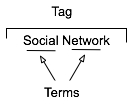
multiterm tag constructionThe multi-term tag is one of the more helpful elements in tagging as it provides the capability to use related terms. These multi-term tags provide depth to understanding when keeping the related tag terms together. But the interfaces for doing this are more complex and confusing than they should be for human, as well as machine consumption.

In the instance illustrated to the tag is comprised or two related terms: social and network. When the tool references the tag, it is looking at both parts as a tag set, which has a distinct meaning. The individual terms can be easily used for searches seeking either of those terms, but knowing the composition of the set, it is relatively easy for the service to offer up "social network" when a person seeks just social or network in a search query.

One common hindrance with social bookmarking adoption is those familiar with it and fans of it for enterprise use point to Delicious, which has a couple huge drawbacks. The compound multi-term tag or disconnected multi-term tags is a deep drawback for most regular potential users (the second is lack of privacy for shared group items). Delicious breaks a basic construct in user focussed design: Tools should embrace human methods of interaction and not humans embracing tech constraints. Delicious is quite popular with those of us malleable in our approach to adopt a technology where we adapt our approach, but that percentage of potential people using the tools is quite thin as a percentage of the population.. Testing this concept takes very little time to prove.

So, what are the options? Glad you asked. But, first a quick additional excursion into why this matters.

Conceptual Models Missing in Social Tool Adoption

One common hinderance for social tool adoption is most people intended to use the tools are missing the conceptual model for what these tools do, the value they offer, and how to personally benefit from these values. There are even change costs involved in moving from a tool that may not work for someone to something that has potential for drastically improved value. The "what it does", "what value it has", and "what situations" are high enough hurdles to cross, but they can be done with some ease by people who have deep knowledge of how to bridge these conceptual model gaps.

What the tools must not do is increase hurdles for adoption by introducing foreign conceptual models into the understanding process. The Delicious model of multi-term tagging adds a very large conceptual barrier for many & it become problematic for even considering adoption. Optimally, Delicious should not be used alone as a means to introduce social bookmarking or tagging.

We must remove the barriers to entry to these powerful offerings as much as we can as designers and developers. We know the value, we know the future, but we need to extend this. It must be done now, as later is too late and these tools will be written off as just as complex and cumbersome as their predecessors.

If you are a buyer of these tools and services, this is you guideline for the minimum of what you should accept. There is much you should not accept. On this front, you need to push back. It is your money you are spending on the products, implementation, and people helping encourage adoption. Not pushing back on what is not acceptable will greatly hinder adoption and increase the costs for more people to ease the change and adoption processes. Both of these costs should not be acceptable to you.

Multi-term Tag UI Options

Compound Terms

I am starting with what we know to be problematic for broad adoption for input. But, compound terms also create problems for search as well as click retrieval. There are two UI interaction patterns that happen with compound multi-term tags. The first is the terms are mashed together as a compound single word, as shown in this example from Delicious.

Tag sample from Delicious

The problem here is the mashing the string of terms "architecture is politics" into one compound term "architectureispolitics". Outside of Germanic languages this is problematic and the compound term makes a quick scan of the terms by a person far more difficult. But it also complicates search as the terms need to be broken down to even have LIKE SQL search options work optimally. The biggest problem is for humans, as this is not natural in most language contexts. A look at misunderstood URLs makes the point easier to understand (Top Ten Worst URLs)

The second is an emergent model for compound multi-term tags is using a term delimiter. These delimiters are often underlines ( _ ), dots ( . ), or hyphens ( - ). A multi-term tag such as "enterprise search" becomes "enterprise.search", "enterprise_search" and "enterprise-search".

While these help visually they are less than optimal for reading. But, algorithmically this initially looks to be a simple solution, but it becomes more problematic. Some tools and services try to normalize the terms to identify similar and relevant items, which requires a little bit of work. The terms can be separated at their delimiters and used as properly separated terms, but since the systems are compound term centric more often than not the terms are compressed and have similar problems to the other approach.

Another reason this is problematic is term delimiters can often have semantic relevance for tribal differentiation. This first surface terms when talking to social computing researchers using Delicious a few years ago. They pointed out that social.network, social_network, and social-network had quite different communities using the tags and often did not agree on underlying foundations for what the term meant. The people in the various communities self identified and stuck to their tribes use of the term differentiated by delimiter.

The discovery that these variations were not fungible was an eye opener and quickly had me looking at other similar situations. I found this was not a one-off situation, but one with a fair amount of occurrence. When removing the delimiters between the terms the technologies removed the capability of understanding human variance and tribes. This method also breaks recommendation systems badly as well as hindering the capability of augmenting serendipity.

So how do these tribes identify without these markers? Often they use additional tags to identity. The social computing researchers add "social computing", marketing types add "marketing", etc. The tools then use their filtering by co-occurrence of tags to surface relevant information (yes, the ability to use co-occurrence is another tool essential). This additional tag addition help improve the service on the whole with disambiguation.

Disconnected Multi-term Tags

The use of distinct and disconnected term tags is often the intent for space delimited sites like Delicious, but the emergent approach of mashing terms together out of need surfaced. Delicious did not intend to create mashed terms or delimited terms, Joshua Schachter created a great tool and the community adapted it to their needs. Tagging services are not new, as they have been around for more than two decades already, but how they are built, used, and platforms are quite different now. The common web interface for tagging has been single terms as tags with many tags applied to an object. What made folksonomy different from previous tagging was the inclusion of identity and a collective (not collaborative) voice that intelligent semantics can be applied to.

The downside of disconnected terms in tagging is certainty of relevance between the terms, which leads to ambiguity. This discussion has been going on for more than a decade and builds upon semantic understanding in natural language processing. Did the tagger intend for a relationship between social & network or not. Tags out of the context of natural language constructs provide difficulties without some other construct for sense making around them. Additionally, the computational power needed to parse and pair potential relevant pairings is somethings that becomes prohibitive at scale.

Quoted Multi-term Tags

One of the methods that surfaced early in tagging interfaces was the quoted multi-term tags. This takes becomes #&039;research "social network" blog' so that the terms social network are bound together in the tool as one tag. The biggest problem is still on the human input side of things as this is yet again not a natural language construct. Systematically the downside is these break along single terms with quotes in many of the systems that have employed this method.

What begins with a simple helpful prompt...:

 SlideShare Tag Input UI

Still often can end up breaking as follows (from SlideShare):

SlideShare quoted multi-term tag parsing

Comma Delimited Tags

Non-space delimiters between tags allows for multi-term tags to exist and with relative ease. Well, that is relative ease for those writing Western European languages that commonly use commas as a string separator. This method allows the system to grasp there are multi-term tags and the humans can input the information in a format that may be natural for them. Using natural language constructs helps provide the ability ease of adoption. It also helps provide a solid base for building a synonym repository in and/or around the tagging tools.

Ma.gnolia comma separated multi-term tag output

While this is not optimal for all people because of variance in language constructs globally, it is a method that works well for a quasi-homogeneous population of people tagging. This also takes out much of the ambiguity computationally for information retrieval, which lowers computational resources needed for discernment.

Text Box Per Tag

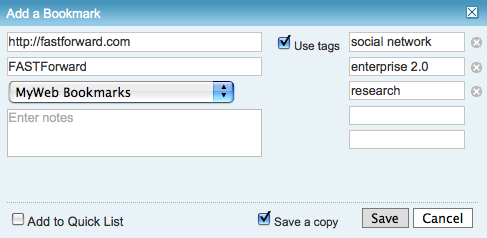
Lastly, the option for input is the text box per tag. This allows for multi-term tags in one text box. Using the tab button on the keyboard after entering a tag the person using this interface will jump down to the next empty text box and have the ability to input a term. I first started seeing this a few years ago in tagging interfaces tools developed in Central Europe and Asia. The Yahoo! Bookmarks 2 UI adopted this in a slightly different implementation than I had seen before, but works much the same (it is shown here).

Yahoo! Bookmarks 2 text box per tag

There are many variations of this type of interface surfacing and are having rather good adoption rates with people unfamiliar to tagging. This approach tied to facets has been deployed in Knowledge Plaza by Whatever s/a and works wonderfully.

All of the benefits of comma delimited multi-term tag interfaces apply, but with the added benefit of having this interface work internationally. International usage not only helps build synonym resources but eases language translation as well, which is particularly helpful for capturing international variance on business or emergent terms.

Summary

This content has come from more than four years of research and discussions with people using tools, both inside enterprise and using consumer web tools. As enterprise moves more quickly toward more cost effective tools for capturing and connecting information, they are aware of not only the value of social tools, but tools that get out the way and allow humans to capture, share, and interact in a manner that is as natural as possible with the tools getting smart, not humans having to adopt technology patterns.

This is a syndicated version of the same post at Optimizing Tagging UI for People & Search :: Personal InfoCloud that has moderated comments available.


11 June 2008

"Building the social web" Full-day Workshop in Copenhagen on June 30th

Through the wonderful cosponsoring of FatDUX I am going to be putting on a full-day workshop Building the Social Web on June 30th in Copenhagen, Denmark (the event is actually in Osterbro). This is the Monday following Reboot, where I will be presenting.

I am excited about the workshop as it will be including much of my work from the past nine months on setting social foundations for successful services, both on the web and inside organizations on the intranet. The workshop will help those who are considering, planning, or already working on social sites to improve the success of the services by providing frameworks that help evaluating and guiding the social interactions on the services.

Space is limited for this workshop to 15 seats and after its announcement yesterday there are only 10 seats left as of this moment.


30 May 2008

Enterprise 2.0 Boston - After Noah: What to do After the Flood (of Information)

I am looking forward to being at the Enterprise 2.0 Conference in Boston from June 10 to June 12, 2008. I am going to be presenting on June 10, 2008 at 1pm on After Noah: Making Sense of the Flood (of Information). This presentation looks at what to expect with social bookmarking tools inside an organization as they scale and mature. It also looks at how to manage the growth as well as encourage the growth.

Last year at the same Enterprise 2.0 conference I presented on Bottom-up Tagging (the presentation is found at Slideshare, Bottom-up All the Way Down: How Tags Help Businesses Organize, which has had over 8,800 viewing on Slideshare), which was more of a foundation presentation, but many in the audience were already running social bookmarking services in-house or trying them in some manner. This year my presentation is for those with an understanding of what social bookmarking and folksonomy are and are looking for what to expect and how to manage what is happening or will be coming along. I will be covering how to manage heavy growth as well as how to increase adoption so there is heavy usage to manage.

I look forward to seeing you there. Please say hello, if you get a chance.


7 May 2008

Enterprise Social Tools: Components for Success

One of the things I continually run across talking with organizations deploying social tools inside their organization is the difficultly getting all the components to mesh. Nearly everybody is having or had a tough time with getting employees and partners to engage with the services, but everybody is finding out it is much more than just the tools that are needed to consider. The tools provide the foundation, but once service types and features are sorted out, it get much tougher. I get frustrated (as do many organizations whom I talk with lately) that social tools and services that make up enterprise 2.0, or whatever people want to call it, are far from the end of the need for getting it right. There is great value in these tools and the cost of the tools is much less than previous generations of enterprise (large organization) offerings.

Social tools require much more than just the tools for their implementation to be successful. Tool selection is tough as no tool is doing everything well and they all are focussing on niche areas. But, as difficult as the tool selection can be, there are three more elements that make up what the a successful deployment of the tools and can be considered part of the tools.

Four Rings of Enterprise Social Tools
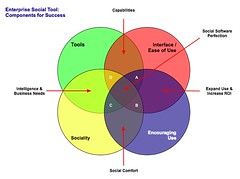
Enterprise Social Tool: Components for Success The four elements really have to work together to make for a successful services that people will use and continue to use over time. Yes, I am using a venn diagram for the four rings as it helps point out the overlaps and gaps where the implementations can fall short. The overlaps in the diagram is where the interesting things are happening. A year ago I was running into organizations with self proclaimed success with deployments of social tools (blogs, wikis, social bookmarking, forums, etc.), but as the desire for more than a simple set of blogs (or whichever tool or set of tools was selected) in-house there is a desire for greater use beyond some internal early adopters. This requires paying close attention to the four rings.

Tools

The first ring is rather obvious, it is the tools. The tools come down to functionality and features that are offered, how they are run (OS, rack mount, other software needed, skills needed to keep them running, etc.), how the tools are integrated into the organization (authentication, back-up, etc.), external data services, and the rest of the the usual IT department checklist. The tools get a lot of attention from many analysts and tech evangelists. There is an incredible amount of attention on widgets, feeds, APIs, and elements for user generated contribution. But, the tools do not get you all of the way to a successful implementation. The tools are not a mix and match proposition.

Interface & Ease of Use

One thing that the social software tools from the consumer web have brought is ease of use and simple to understand interfaces. The tools basically get out of the way and bring in more advanced features and functionality as needed. The interface also needs to conform to expectations and understandings inside an organization to handle the flow of interaction. What works for one organization may be difficult for another organization, largely due to the tools and training, and exposure to services outside their organization. Many traditional enterprise tools have been trying to improve the usability and ease of use for their tools over the last 4 to 5 years or so, but those efforts still require massive training and large binders that walk people through the tools. If the people using the tools (not administering the tools need massive amounts of training or large binders for social software the wrong tool has been purchased).

Sociality

Sociality is the area where people manage their sharing of information and their connections to others. Many people make the assumption that social tools focus on everything being shared with everybody, but that is not the reality in organizations. Most organizations have tight boundaries on who can share what with whom, but most of those boundaries get in the way. One of the things I do to help organizations is help them realize what really needs to be private and not shared is often much less than what they regulate. Most people are not really comfortable sharing information with people they do not know, so having comfortable spaces for people to share things is important, but these spaces need to have permeable walls that encourage sharing and opening up when people are sure they are correct with their findings.

Sociality also includes the selective groups people belong to in organizations for project work, research, support, etc. that are normal inside organizations to optimize efficiency. But, where things get really difficult is when groups are working on similar tasks that will benefit from horizontal connections and sharing of information. This horizontal sharing (as well as diagonal sharing) is where the real power of social tools come into play as the vertical channels of traditional organization structures largely serve to make organizations inefficient and lacking intelligence. The real challenge for the tools is the capability to surface the information of relevance from selective groups to other selective groups (or share information more easily out) along the way. Most tools are not to this point yet, largely because customers have not been asking for this (it is a need that comes from use over time) and it can be a difficult problem to solve.

One prime ingredient for social tool use by people is providing a focus on the people using the tools and their needs for managing the information they share and the information from others that flow through the tool. Far too often the tools focus on the value the user generated content has on the system and information, which lacks the focus of why people use the tools over time. People use tools that provide value to them. The personal sociality elements of whom are they following and sharing things with, managing all contributions and activities they personally made in a tool, ease of tracking information they have interest in, and making modifications are all valuable elements for the tools to incorporate. The social tools are not in place just to serve the organization, they must also serve the people using the tools if adoption and long term use important.

Encouraging Use

Encouraging use and engagement with the tools is an area that all organizations find they have a need for at some point and time. Use of these tools and engagement by people in an organization often does not happen easily. Why? Normally, most of the people in the organization do not have a conceptual framework for what the tools do and the value the individuals will derive. The value they people using the tools will derive needs to be brought to the forefront. People also usually need to have it explained that the tools are as simple as they seem. People also need to be reassured that their voice matters and they are encouraged to share what they know (problems, solutions, and observations).

While the egregious actions that happen out on the open web are very rare inside an organization (transparency of who a person is keeps this from happening) there is a need for a community manager and social tool leader. This role highlights how the tools can be used. They are there to help people find value in the tools and provide comfort around understanding how the information is used and how sharing with others is beneficial. Encouraging use takes understanding the tools, interface, sociality, and the organization with its traditions and ways of working.

The Overlaps

The overlaps in the graphic are where things really start to surface with the value and the need for a holistic view. Where two rings over lap the value is easy to see, but where three rings overlap the missing element or element that is deficient is easier to understand its value.

Tools and Interface

Traditional enterprise offerings have focussed on the tools and interface through usability and personalization. But the tools have always been cumbersome and the interfaces are not easy to use. The combination of the tools and interface are the core capabilities that traditionally get considered. The interface is often quite flexible for modification to meet an organizations needs and desires, but the capabilities for the interface need to be there to be flexible. The interface design and interaction needs people who have depth in understanding the broad social and information needs the new tools require, which is going to be different than the consumer web offerings (many of them are not well thought through and do not warrant copying).

Tools and Sociality

Intelligence and business needs are what surface out of the tools capabilities and sociality. Having proper sociality that provides personal tools for managing information flows and sharing with groups as well as everybody as it makes sense to an individual is important. Opening up the sharing as early as possible will help an organization get smarter about itself and within itself. Sociality also include personal use and information management, which far few tools consider. This overlap of tools and sociality is where many tools are needing improvement today.

Interface and Encouraging Use

Good interfaces with easy interaction and general ease of use as well as support for encouraging use are where expanding use of the tools takes place, which in turn improves the return on investment. The ease of use and simple interfaces on combined with guidance that provides conceptual understanding of what these tools do as well as providing understanding that eases fears around using the tools (often people are fearful that what they share will be used against them or their job will go away because they shared what they know, rather than they become more valuable to an organization by sharing as they exhibit expertise). Many people are also unsure of tools that are not overly cumbersome and that get out of the way of putting information in to the tools. This needs explanation and encouragement, which is different than in-depth training sessions.

Sociality and Encouraging Use

The real advantages of social tools come from the combination of getting sociality and encouraging use correct. The sociality component provides the means to interact (or not) as needed. This is provided by the capabilities of the product or products used. This coupled with a person or persons encouraging use that show the value, take away the fears, and provide a common framework for people to think about and use the tools is where social comfort is created. From social comfort people come to rely on the tools and services more as a means to share, connect, and engage with the organization as a whole. The richness of the tools is enabled when these two elements are done well.

The Missing Piece in Overlaps

This section focusses on the graphic and the three-way overlaps (listed by letter: A; B; C; and D). The element missing in the overlap or where that element is deficient is the focus.

Overlap A

This overlap has sociality missing. When the tool, interface, and engagement are solid, but sociality is not done well for an organization there may be strong initial use, but use will often stagnate. This happens because the sharing is not done in a manner that provides comfort or the services are missing a personal management space to hold on to a person's own actions. Tracking one's own actions and the relevant activities of others around the personal actions is essential to engaging socially with the tools, people, and organization. Providing comfortable spaces to work with others is essential. One element of comfort is built from know who the others are whom people are working with, see Elements of Social Software and Selective Sociality and Social Villages (particularly the build order of social software elements) to understand the importance.

Overlap B

This overlap has tools missing, but has sociality, interface, and encouraging use done well. The tools can be deficient as they may not provide needed functionality, features, or may not scale as needed. Often organizations can grow out of a tool as their needs expand or change as people use the tools need more functionality. I have talked with a few organizations that have used tools that provide simple functionality as blogs, wikis, or social bookmarking tools find that as the use of the tools grows the tools do not keep up with the needs. At times the tools have to be heavily modified to provide functionality or additional elements are needed from a different type of tool.

Overlap C

Interface and ease of use is missing, while sociality, tool, and encouraging use are covered well. This is an area where traditional enterprise tools have problems or tools that are built internally often stumble. This scenario often leads to a lot more training or encouraging use. Another downfall is enterprise tools are focussed on having their tools look and interact like consumer social web tools, which often are lacking in solid interaction design and user testing. The use of social tools in-house will often not have broad use of these consumer services so the normal conventions are not understood or are not comfortable. Often the interfaces inside organizations will need to be tested and there many need to be more than one interface and feature set provided for depth of use and match to use perceptions.

Also, what works for one organization, subset of an organization, or reviewer/analyst will not work for others. The understanding of an organization along with user testing and evaluation with a cross section of real people will provide the best understanding of compatibility with interface. Interfaces can also take time to take hold and makes sense. Interfaces that focus on ease of use with more advanced capabilities with in reach, as well as being easily modified for look and interactions that are familiar to an organization can help resolve this.

Overlap D

Encouraging use and providing people to help ease people's engagement is missing in many organizations. This is a task that is often overlooked. The tools, interface, and proper sociality can all be in place, but not having people to help provide a framework to show the value people get from using the tools, easing concerns, giving examples of uses for different roles and needs, and continually showing people success others in an organization have with the social tool offerings is where many organization find they get stuck. The early adopters in an organization may use the tools as will those with some familiarity with the consumer web social services, but that is often a small percentage of an organization.

Summary

All of this is still emergent and early, but these trends and highlights are things I am finding common. The two areas that are toughest to get things right are sociality and encouraging use. Sociality is largely dependent on the tools, finding the limitations in the tools takes a fair amount of testing often to find limitations. Encouraging use is more difficult at the moment as there are relatively few people who understand the tools and the context that organizations bring to the tools, which is quite different from the context of the consumer social web tools. I personally only know of a handful or so of people who really grasp this well enough to be hired. Knowing the "it depends moments" is essential and knowing that use is granular as are the needs of the people in the organization. Often there are more than 10 different use personas if not more that are needed for evaluating tools, interface, sociality, and encouraging use (in some organizations it can be over 20). The tools can be simple, but getting this mix right is not simple, yet.

[Comments are open and moderated at Enterprise Social Tools: Components for Success :: Personal InfoCloud


3 May 2008

Getting Info into the Field with Extension

This week I was down in Raleigh, North Carolina to speak at National Extension Technology Conference (NETC) 2008, which is for the people running the web and technology components for what used to be the agricultural extension of state universities, but now includes much more. This was a great conference to connect with people trying to bring education, information, and knowledge services to all communities, including those in rural areas where only have dial-up connectivity to get internet access. The subject matter presented is very familiar to many other conferences I attend and present at, but with a slightly different twist, they focus on ease of use and access to information for everybody and not just the relatively early adopters. The real values of light easy to use interfaces that are clear to understand, well structured, easy to load, and include affordance in the initial design consideration is essential.

I sat in on a few sessions, so to help tie my presentation to the audience, but also listen to interest and problems as they compare to the organizations I normally talk to and work with (mid-size member organizations up to very large global enterprise). I sat in on a MOSS discussion. This discussion about Sharepoint was indiscernible from any other type of organization around getting it to work well, licensing, and really clumsy as well as restrictive sociality. The discussion about the templates for different types of interface (blogs and wikis) were the same as they they do not really do or act like the template names. The group seemed to have less frustration with the wiki template, although admitted it was far less than perfect, it did work to some degree with the blog template was a failure (I normally hear both are less than useful and only resemble the tools in name not use). [This still has me thinking Sharepoint is like the entry drug for social software in organizations, it looks and sounds right and cool, but is lacking the desired kick.]

I also sat down with the project leads and developers of an eXtension wide tool that is really interesting to me. It serves the eXtension community and they are really uncoupling the guts of the web tools to ease greater access to relevant information. This flattening of the structures and new ways of accessing information is already proving beneficial to them, but it also has brought up the potential to improve ease some of the transition for those new to the tools. I was able to provide feedback that should provide a good next step. I am looking forward to see that tool and the feedback in the next three to six months as it has incredible potential to ease information use into the hands that really need it. It will also be a good example for how other organizations can benefit from similar approaches.

Comments are open (with usual moderation) at this post at Getting Info into the Field with Extension :: Personal InfoCloud.


16 April 2008

Explaining the Granular Social Network

This post on Granular Social Networks has been years in the making and is a follow-up to one I previously made in January 2005 on Granular Social Networks as a concept I had been presenting and talking about for quite some time at that point. In the past few years it has floated in and out of my presentations, but is quite often mentioned when the problems of much of the current social networking ideology comes up. Most of the social networking tools and services assume we are broadline friends with people we connect to, even when we are just "contacts" or other less than "friend" labels. The interest we have in others (and others in us) is rarely 100 percent and even rarer is that this 100 percent interest and appreciation is equal in both directions (I have yet to run across this in any pairing of people, but I am open to the option that it exists somewhere).

Social Tools Need to Embrace Granularity

What we have is partial likes in others and their interests and offerings. Our social tools have yet to grasp this and the few that do have only taken small steps to get there (I am rather impressed with Jaiku and their granular listening capability for their feed aggregation, which should be the starting point for all feed aggregators). Part of grasping the problem is a lack of quickly understanding the complexity, which leads to deconstructing and getting to two variables: 1) people (their identities online and their personas on various services) and 2) interests. These two elements and their combinations can (hopefully) be seen in the quick annotated video of one of my slides I have been using in presentations and workshops lately.

Showing Granular Social Network


Granular Social Network from Thomas Vander Wal on Vimeo.

The Granular Social Network begins with one person, lets take the self, and the various interest we have. In the example I am using just five elements of interest (work, music, movies, food, and biking). These are interest we have and share information about that we create or find. This sharing may be on one service or across many services and digital environments. The interests are taken as a whole as they make up our interests (most of us have more interests than five and we have various degrees of interest, but I am leaving that out for the sake of simplicity).

Connections with Others

Our digital social lives contain our interests, but as it is social it contains other people who are our contacts (friends is presumptive and gets in the way of understanding). These contacts have and share some interests in common with us. But, rarely do the share all of the same interest, let alone share the same perspective on these interests.

Mapping Interests with Contacts

But, we see when we map the interests across just six contacts that this lack of fully compatible interests makes things a wee bit more complicated than just a simple broadline friend. Even Facebook and their touted social graph does not come close to grasping this granularity as it is still a clumsy tool for sharing, finding, claiming, and capturing this granularity. If we think about trying a new service that we enjoy around music we can not easily group and capture then try to identify the people we are connected to on that new service from a service like Facebook, but using another service focussed on that interest area it could be a little easier.

When we start mapping our own interest back to the interest that other have quickly see that it is even more complicated. We may not have the same reciprocal interest in the same thing or same perception or context as the people we connect to. I illustrate with the first contact in yellow that we have interest in what they share about work or their interest in work, even though they are not stating or sharing that information publicly or even in selective social means. We may e-mail, chat in IM or talk face to face about work and would like to work with them in some manner. We want to follow what they share and share with them in a closer manner and that is what this visual relationship intends to mean. As we move across the connections we see that the reciprocal relationships are not always consistent. We do not always want to listen to all those who are sharing things, with use or the social collective in a service or even across services.

Focus On One Interest

Taking the complexity and noise out of the visualization the focus is placed on just music. We can easily see that there are four of our six contacts that have interest in music and are sharing their interest out. But, for various reasons we only have interests in what two of the four contacts share out. This relationship is not capturing what interest our contacts have in what we are sharing, it only captures what they share out.

Moving Social Connections Forward

Grasping this as a relatively simple representation of Granular Social Networks allows for us to begin to think about the social tools we are building. They need to start accounting for our granular interests. The Facebook groups as well as listserves and other group lists need to grasp the nature of individuals interests and provide the means to explicitly or implicitly start to understand and use these as filter options over time. When we are discussing portable social networks this understanding has be understood and the move toward embracing this understanding taken forward and enabled in the tools we build. The portable social network as well as social graph begin to have a really good value when the who is tied with what and why of interest. We are not there yet and I have rarely seen or heard these elements mentioned in the discussions.

One area of social tools where I see this value beginning to surface in through tagging for individuals to start to state (personally I see this as a private or closed declaration that only the person tagging see with the option of sharing with the person being tagged, or at least have this capability) the reasons for interest. But, when I look at tools like Last.fm I am not seeing this really taking off and I hear people talking about not fully understanding tagging as as it sometimes narrows the interest too narrowly. It is all an area for exploration and growth in understanding, but digital social tools, for them to have more value for following and filtering the flows in more manageable ways need to more in grasping this more granular understanding of social interaction between people in a digital space.


11 April 2008

YouTube New Interface and Social Interaction Design Santiy Check

YouTube has released a new design for the site and its individual video pages. This gets shared in Google Operating System :: User Inferface Updates at YouTube and TechCrunch :: YouTube Updates Layout, Now with Tabs and Statistics. While the new design looks nice and clean, it has one design bug that is horribly annoying it has mixed interaction design metaphors for its tabs or buttons.

Broken Interaction Design on Buttons or Tabs

YouTube New Video Interface As the image shows the Share, Favorite, Playlists, and Flag buttons or tabs all have similar design treatment, but they do not have the same actions when you click on them. Three of the items (Share, Playlists, and Flag) all act as tabs that open up a larger area below them to provide more options and information. But, the Favorites acts like a button that when clicked it marks the item as a favorite.

This is incredibly poor interaction design as all the items should act in the same manner. If the items do not have the same action properties they really should not look the same and be in the same action space. Favorites should be a check box or a binary interface for on and off. That interaction patter more closely matches the Rate section and seems like it should have been there rather than showing a lack of understanding interaction design basics and confusing people using the site/service.

Social Sites Seem to Share a Lack of Interaction Understanding

This should have been a no brainer observation for a design manager or somebody with a design sanity check. YouTube is far from the the only site/service doing this. Nearly all of the services are not grasping the basics or are broadly applying design patterns to all user scenarios when they really do not fit all scenarios and user types (nearly every service I talk to know exactly the use type a person fits into but never takes this into account in optimization of design patterns that match that use need). Facebook really falls into this hole badly and never seems to grasp they are really making a mess of things the more features and functionality they are bringing into their service without accounting for the design needs in the interface.

My seemingly favorite site to nit pick is LinkedIn which I use a lot and has been a favorite, but their social interaction additions and interactive interfaces really need much better sanity checks and testing before they go into production (even into the beta interface). LinkedIn is really trying to move forward and they are moving in the right direction, but they really need better design thinking with their new features and functionality. Their new design is ready to handle some of the new features, but the features need a lot more refining. The new design shows they have a really good grasp that the interface needs to be a flexible foundation to be used as a framework for including new features, which could benefit from treating them as options for personalization. LinkedIn has pulled back many of the social features and seems to be rethinking them and refining them, but they really need some good sanity checks before rolling them out again.

Social Interaction in Enterprise Tools

The befuddled interaction understanding is not germane to commercial or consumer public social web sites, but it also plagues tools aimed at the enterprise. This is not overly surprising as many of the social enterprise (enterprise 2.0) tools and services are copying the public web tools and services to a large degree. This is a good thing, as it puts the focus on ease of use, which has been horribly missing in business focussed tools for far too long. But, the down side for enterprise focussed tools is they are not for the public web they are for business users, who most often do not have familiarity with the conventions on the public web and they have a large cognitive gap in understanding what the tools do and their value. There is less time for playing and testing in most business people's worklife. This means the tools need to get things right up front with clear understanding of the use needs of the people they are building for in business. This seems to be lacking in many tools as there is much copying of poor design that really needs to be tested thoroughly before launching. Business focussed tools are not hitting the same people as are on the web, which will work through poor design and functionality to see what things do. It is also important to consider that there are a wide variety of types of people using these tools with varying needs and varying interaction understandings (this will be another blog post, actually a series of posts that relate to things I have been including in workshops the last six months and presenting the last couple).

[Comments are available and moderated as usual at: YouTube New Interface and Social Interaction Design Santiy Check :: Personal InfoCloud]


10 April 2008

Denning and Yaholkovsky on Real Collaboration

The latest edition of the Communications of the ACM (Volume 51, Issue 4 - April 2008) includes an article on Getting to "we", which starts off by pointing out the misuse and mis-understanding of the term collaboration as well as the over use of the practice of collaboration when it is not proper for the need. The authors Peter Denning and Peter Yaholkovsky break down the tools needed for various knowledge needs into four categories: 1) Information sharing; 2) Coordination; 3) Cooperation; and Collaboration. The authors define collaboration as:

Collaboration generally means working together synergistically. If your work requires support and agreement of others before you can take action, you are collaborating.

The article continues on to point out that collaboration is often not the first choice of tools we should reach for, as gathering information, understanding, and working through options is really needed in order to get to the stages of agreement. Their article digs deeply into the resolving "messy problems" through proper collaboration methods. To note, the wiki - the usual darling of collaboration - is included in their "cooperation" examples and not Collaboration. Most of the tools many businesses consider in collaboration tools are in the lowest level, which is "information sharing". But, workflow managment falls into the coordination bucket.

This is one of the better breakdowns of tool sets I have seen. The groupings make a lot of sense and their framing of collaboration to take care of the messiest problems is rather good, but most of the tools and services that are considered to be collaborations tools do not even come close to that description or to the capabilities required.

[Comments are open at Denning and Yaholkovsky on Real Collaboration :: Personal InfoCloud]


6 April 2008

Selective Sociality and Social Villages

The web provides wonderful serendipity on many fronts, but in this case it brought together two ideas I have been thinking about, working around, and writing about quite a bit lately. The ideas intersect at the junction of the pattern of building social bonds with people and comfort of know interactions that selective sociality brings.

The piece that struck me regarding building and identifying a common bond with another person came out of Robert Paterson's "Mystery of Attraction" post (it is a real gem). Robert describes his introduction and phases of getting to know and appreciate Luis Suarez (who I am a huge fan of and deeply appreciate the conversations I have with him). What Robert lays out in his introduction (through a common friend on-line) is a following of each other's posts and digital trail that is shared out with others. This builds an understanding of each others reputation in their own minds and the shared interest. Upon this listening to the other and joint following they built a relationship of friendship and mutual appreciation (it is not always mutual) and they began to converse and realized they had a lot more in common.

Elements of Social Software Build Order What Robert echos is the Elements in Social Software and its build order. This build order is common in human relationships, but quite often social software leaves out steps or expects conversations, groups, and collaboration to happen with out accounting for the human elements needed to get to this stage. Quite often the interest, ideas, and object (all social objects) are the stimulus for social interaction as they are the hooks that connect us. This is what makes the web so valuable as it brings together those who are near in thought and provides a means to connect, share, and listen to each other. I really like Robert's analogy of the web being like university.

Selective Sociality of Villages

The piece that resonated along similar threads to Robert's post is Susan Mernit's "Twitter & Friend Feed: The Pleasure of Permissions". Susan's post brings to light the value of knowing who you are sharing information with and likes the private or permission-based options that both Twitter and FriendFeed offer. This selective sociality as known Local InfoCloud of people and resources that are trusted and known, which we use as resources. In this case it is not only those with whom we listen to and query, but those with whom we share. This knowing who somebody is (to some degree) adds comfort, which is very much like Robert Patterson and Luis Suarez#039; villages where people know each other and there is a lot of transparency. Having pockets where our social armor is down and we can be free to share and participate in our lives with others we know and are familiar to us is valuable.

I am found these two pieces quite comforting as they reflect much of what I see in the physical community around me as well as the work environments I interact with of clients and collaborators. The one social web service I have kept rather private is Twitter and I really want to know who someone is before I will accept them as a connection. This has given me much freedom to share silly (down right stupid - in a humorous way) observations and statements. This is something I hear from other adults around kids playgrounds and practices of having more select social interactions on line in the services and really wanting to connect with people whom they share interests and most often have known (or followed/listened to) for sometime before formally connecting. Most often these people want to connect with the same people on various services they are trying out, based on recommendation (and often are leaving a service as their friends are no longer there or the service does not meet their needs) of people whom they trust. This is the core of the masses who have access and are not early adopters, but have some comfort with the web and computers and likely make up 80 to 90 percent of web users.

[Comments are open (with moderation as always) on this post at Selective Sociality and Social Villages :: Personal InfoCloud]


This work is licensed under the Creative Commons Attribution-NonCommercial-ShareAlike License.